Lesson reading
live
15 min
Start with the lesson question, connect the representations, and test the model with evidence.
Inspect the opening phenomenon
Predict what changes, then name the evidence.
Apply in the lab
Name the evidence before reading the answer.
Read only what helps
Then use the lab and recall check.
More when needed
Transcript and resources stay available below.
Course progress
Torque, Equilibrium, and Angular Acceleration
Decision challenge
Use the opening example to make a prediction, identify evidence, and explain which model supports it.
Predict whether pushing harder near a door hinge always produces more rotation than a lighter push near the handle.
Predict which push rotates the door most, calculate torque, and test the zero-lever-arm case.
Before
Predict whether pushing harder near a door hinge always produces more rotation than a lighter push near the handle.
During
Pause before the calculation. Evaluate r F sine theta for 40 newtons, 0.25 meters, and 60 degrees.
After
Explain why a force aimed through the hinge produces zero torque and why a farther perpendicular push produces more torque.
Lesson reading
live
15 min
Video script
draft
Transcript fallback
available
courses/ap-physics-1/modules/05-torque-and-rotational-dynamics/lessons/01-torque-equilibrium-and-angular-acceleration/video-transcript.md
Torque Balance and Unknown Mass
draft
1 hr 20 min
Mastery check
live
7 questions / 15 min
# Accessible transcript: Why Pushing Harder Can Fail You can push a door hard and still create zero torque. Torque depends on force and the perpendicular lever arm from the axis to the force's line of action. Push with forty newtons, point two five meters from the hinge, at sixty degrees. Multiply radius, force, and sine sixty: eight point six six newton-meters. Aim that same force through the hinge, and the lever arm becomes zero. So does torque. Quick check: same perpendicular force—does the near push or far push create more torque? Pause. The farther push. Torque is force times lever arm. Master rotational dynamics free at EduQuest AI. ## Visual description A top-down door diagram marks the hinge, force application point, force direction, angle, and perpendicular lever arm. The force line then rotates through the hinge, making the lever arm zero. A final comparison shows identical perpendicular forces applied near and far from the hinge.
Reading lab
Connect the lesson's words, diagrams, graphs, evidence, and equations.
How do force location and mass distribution affect rotational change?
Imagine pushing a door with the same force in three ways: near the hinge, far from the hinge, and directly toward the hinge. Rank the resulting rotational effects and explain what matters besides force magnitude.
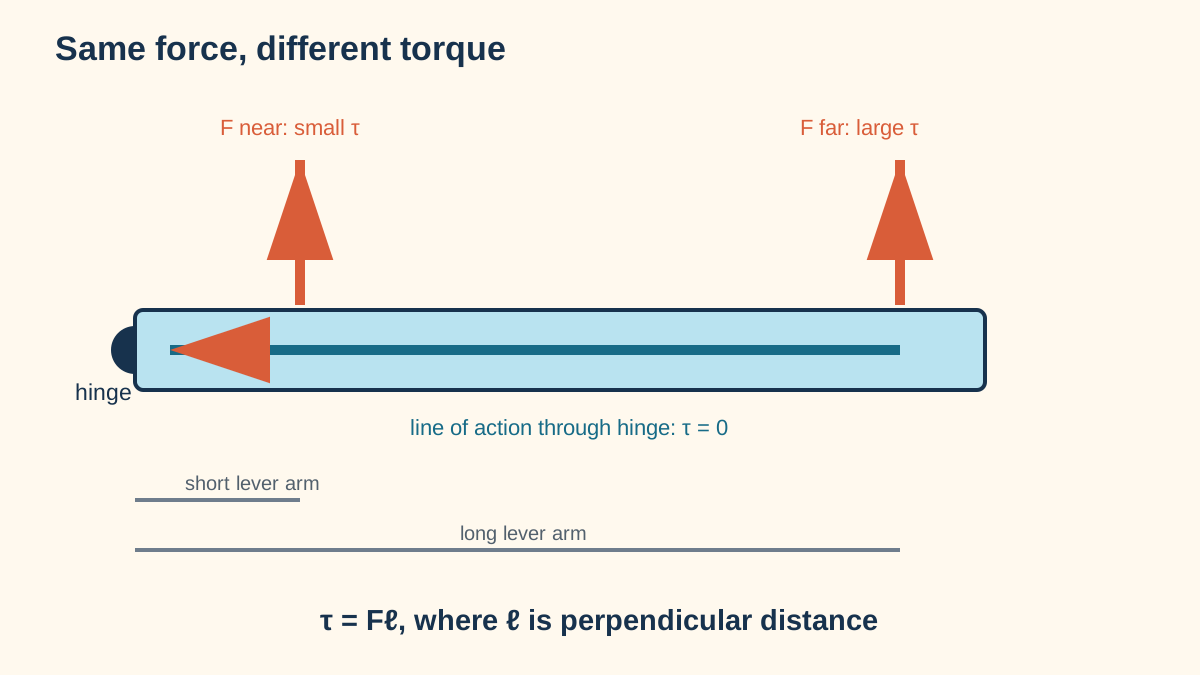
A large force directed through a pivot produces zero torque about that pivot. A smaller perpendicular force farther away can rotate the object. Rotational effect depends on where, how, and about which axis a force acts.
The torque of a force about an axis is
Its magnitude is
where is the angle between and , and is the perpendicular lever arm. Torque units are , not joules, because torque is not energy.
In planar problems, choose a sign convention—commonly counterclockwise positive and clockwise negative—and state it.
A force acts from a bolt at to the wrench handle:
The sign depends on the rotation tendency. Only the force component perpendicular to the handle contributes.
Static equilibrium requires both
and
Zero net force alone prevents translational acceleration but not angular acceleration. Zero net torque alone prevents angular acceleration but not translational acceleration.
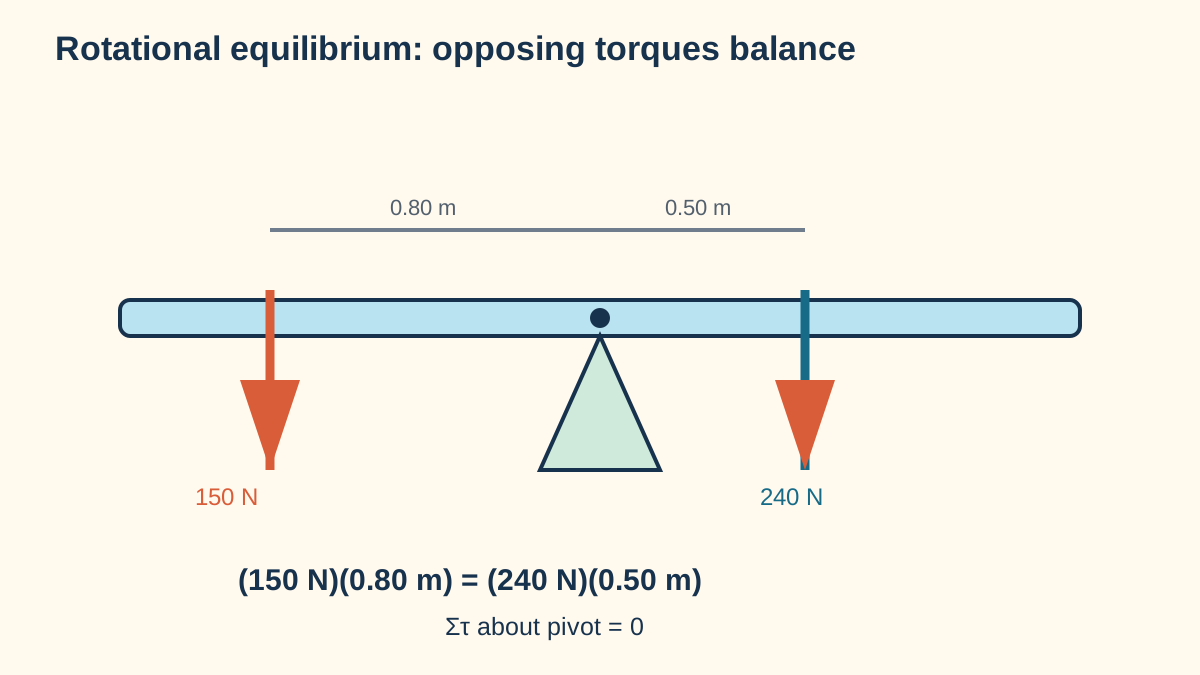
A negligible-mass horizontal beam pivots at its center. A load hangs left of the pivot. Where must a load hang on the right for equilibrium?
Taking counterclockwise positive,
so . The pivot force produces zero torque about the pivot because its lever arm is zero.
Net torque may be computed about any axis, but the torque values depend on that choice. In equilibrium, choose a pivot through an unknown support force to eliminate that force from the torque equation. Then use force balance to find the remaining support components.
For an extended object, gravitational force acts effectively at its center of mass in a uniform gravitational field.
For a rigid body rotating about a fixed axis,
where is rotational inertia and is angular acceleration. This resembles , but depends on how mass is distributed relative to the axis:
Moving the same mass farther from the axis increases and reduces for the same net torque.
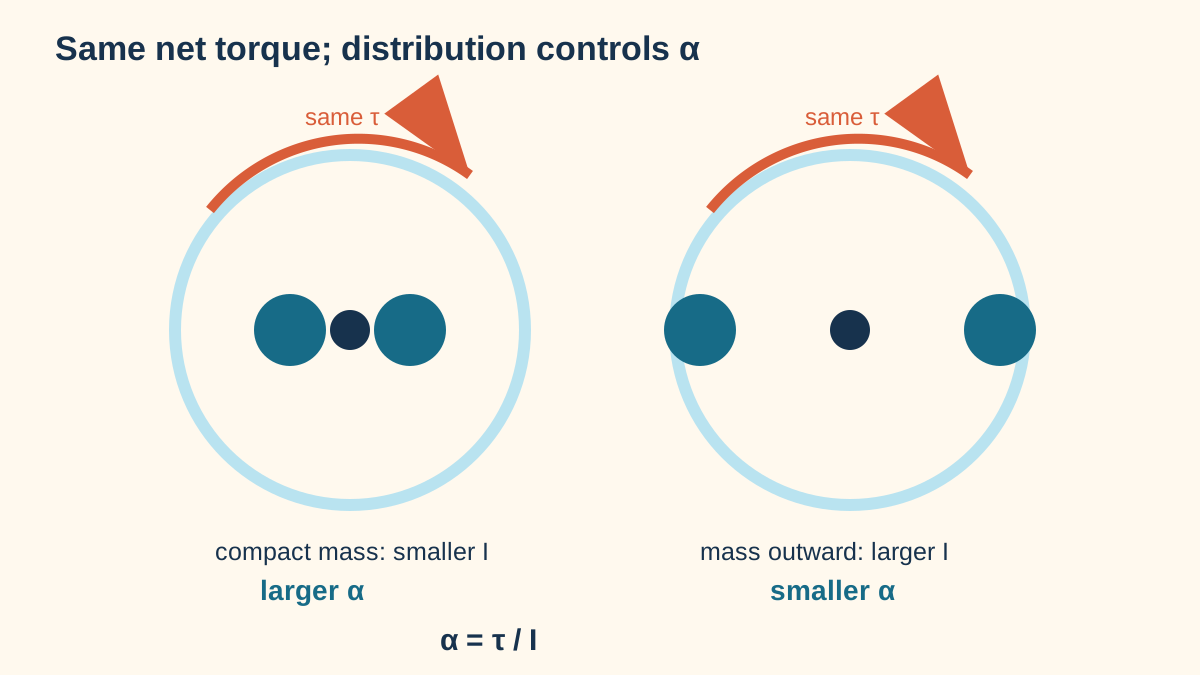
Two wheels receive the same constant net torque . Wheel A has and wheel B has :
The smaller rotational inertia yields the larger angular acceleration.
For each scenario:
A string wrapped around a pulley applies torque . If the string does not slip, tangential and angular accelerations satisfy
The tension on two sides of a massive accelerating pulley need not be equal; their difference supplies net torque.
“Any force produces rotation.” A force through the axis has zero lever arm and zero torque about that axis.
“Torque is a force.” Torque is a rotational effect calculated from force and lever arm.
“Moment of inertia depends only on mass.” It depends on mass distribution and axis location.
“If net force is zero, the object is fully balanced.” Rotational equilibrium also requires zero net torque.
“The longest radius always means the greatest torque.” Force angle also matters through .
Rotation is controlled by net torque and rotational inertia. A defensible model always names the axis, locates each force, and accounts for mass distribution.
Can rotational equilibrium determine an unknown mass, and how does pivot choice affect uncertainty?
Work under teacher or responsible-adult supervision. Use only low-mass objects, secure the pivot and stand, keep feet and faces away from hanging masses, add masses only while the beam is supported, and use a catch tray. Do not overload rulers, clamps, strings, or supports. Stop if anything slips or bends.
Low-cost alternative: a sturdy ruler balanced on a fixed rounded pencil, paper-clip hangers, and sealed bags of coins, used at tabletop height.
Simulation alternative: a teacher-approved balance simulation. Record the same distances and explain which friction and placement uncertainties it omits.
Clockwise and counterclockwise torques should balance within measurement uncertainty. Independent trials should yield consistent estimates of the unknown mass, and configurations with longer lever arms should generally reduce fractional distance uncertainty.
Use both
and
Claim whether rotational equilibrium predicted the unknown mass within uncertainty. Cite trial estimates, spread, and validation measurement, then connect the evidence to balanced torque and model limitations.
Offer roles for safety, placement, tactile measurement, reading values, recording, uncertainty analysis, and oral explanation. Use high-contrast position markers, large-print/tactile scales, screen-reader-friendly tables, and verbal descriptions. Learners can complete all analysis from shared raw data without handling hanging masses.
Choose a new pivot location and predict one placement that will rebalance the same objects without trial-and-error. Test the prediction once and explain the discrepancy using measurement uncertainty.