Lesson reading
live
20 min
Start with the lesson question, connect the representations, and test the model with evidence.
Inspect the opening phenomenon
Predict what changes, then name the evidence.
Apply in the lab
Name the evidence before reading the answer.
Read only what helps
Then use the lab and recall check.
More when needed
Transcript and resources stay available below.
Course progress
Interactions, Forces, and Newton's Laws
Decision challenge
Use the opening example to make a prediction, identify evidence, and explain which model supports it.
Predict whether an object can move right while its net force points left. Explain what will happen to its velocity.
Predict the force direction, watch the worked crate example, and answer the third-law retrieval check.
Before
Predict whether an object can move right while its net force points left. Explain what will happen to its velocity.
During
Track which arrows belong on the crate's free-body diagram and calculate the horizontal net force before the video reveals it.
After
Explain why the book's weight and the table's normal force are not a Newton's-third-law pair, then identify each force's actual partner.
Lesson reading
live
20 min
Video script
draft
Transcript fallback
available
courses/ap-physics-1/modules/02-force-and-translational-dynamics/lessons/01-interactions-forces-and-newtons-laws/video-transcript.md
Test the Net-Force Model
draft
1 hr 30 min
Mastery check
live
6 questions / 15 min
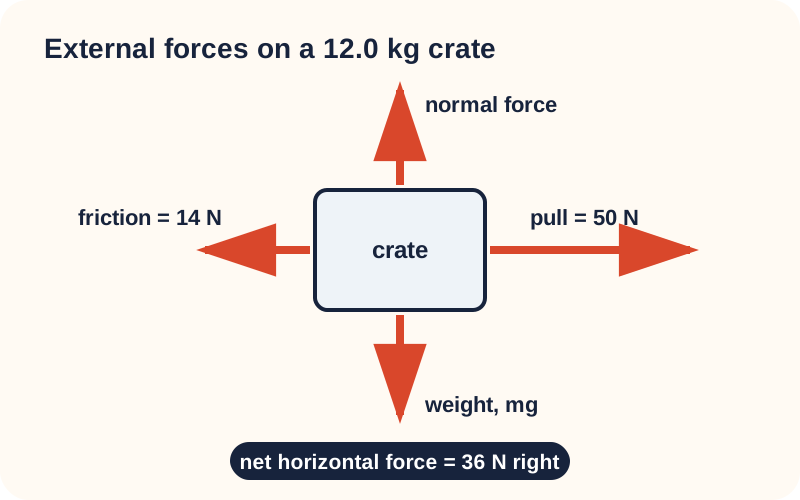
# Accessible transcript: The Free-Body Diagram Test Can something move right while the net force points left? Absolutely. Velocity tells how it moves. Net force tells how its velocity changes. Start by choosing the object, then draw only forces acting on it. A twelve-kilogram crate is pulled right with fifty newtons while friction is fourteen newtons left. The net force is thirty-six newtons right. Divide by mass: acceleration is three meters per second squared right. Third-law forces do not cancel on one free-body diagram. They are equal and opposite, but they act on different objects. Quick check: are the book's weight and the table's normal force a third-law pair? Pause and decide. No—both act on the book. Learn the full force-modeling method free at EduQuest AI. ## Visual descriptions The video first shows a crate moving right with a leftward net-force arrow to distinguish velocity from acceleration. A free-body diagram then shows upward normal force, downward weight, a 50-newton pull right, and 14-newton friction left. A final diagram shows a book with both weight and normal force acting on it, demonstrating that these are not a Newton's-third-law pair.
Reading lab
Connect the lesson's words, diagrams, graphs, evidence, and equations.
How do interactions change the motion of a chosen system?
A bus accelerates forward and a standing passenger appears to lean backward. No mysterious backward force is needed. The passenger's body tends to retain its velocity while the floor exerts a forward friction force on the feet. The observation becomes clear once we choose a system and identify forces on it.
Dynamics connects interactions to changes in motion. Its core reasoning chain is:
choose a system → identify external interactions → draw forces → add vectors → predict acceleration.
A force is a push or pull exerted by one object on another. Name it with two objects: means “force exerted by on .” Force is measured in newtons, where
Common interactions include gravitational force, normal force, tension, friction, drag, and applied contact forces. Velocity and acceleration are not forces.
A free-body diagram isolates one chosen object or system and shows only external forces acting on it.
For a book resting on a level table, Earth pulls downward with and the table pushes upward with . If vertical acceleration is zero, these forces balance. The normal force is not automatically equal to weight; that equality follows only from the vertical force equation in this specific situation.
In an inertial reference frame, an object with zero net external force maintains constant velocity:
Constant velocity includes rest. Motion does not require a continuing net force. A sliding object commonly stops because friction provides a net force opposite its motion.
For constant mass,
This vector equation becomes a component equation for each axis:
Acceleration points in the direction of the net force, not necessarily in the direction of velocity.
A crate is pulled horizontally right with . Kinetic friction is left. Find its acceleration.
Choose right as positive. Vertically, . Horizontally,
so
The applied force is not ; the net force, , is .
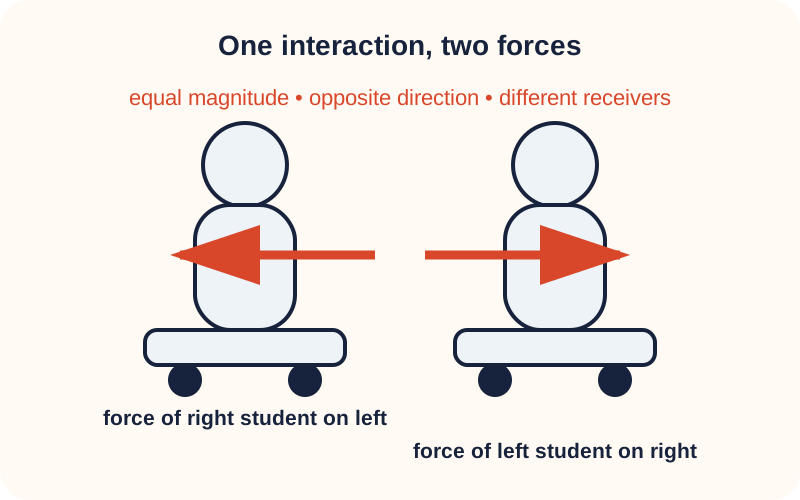
If object exerts a force on object , then simultaneously exerts an equal-magnitude, opposite-direction force on :
The pair never cancels on one free-body diagram because the two forces act on different objects. The book's weight and the table's normal force both act on the book, so they are not a third-law pair. The third-law partner of the table's force on the book is the book's force on the table.
Static friction adjusts up to a maximum:
When surfaces slide, a useful model is
Static friction is not always ; it reaches that value only at impending slip. Friction opposes relative slipping or the tendency to slip, not always the object's velocity.
For a block on an incline of angle , choose axes parallel and perpendicular to the surface. Weight components are
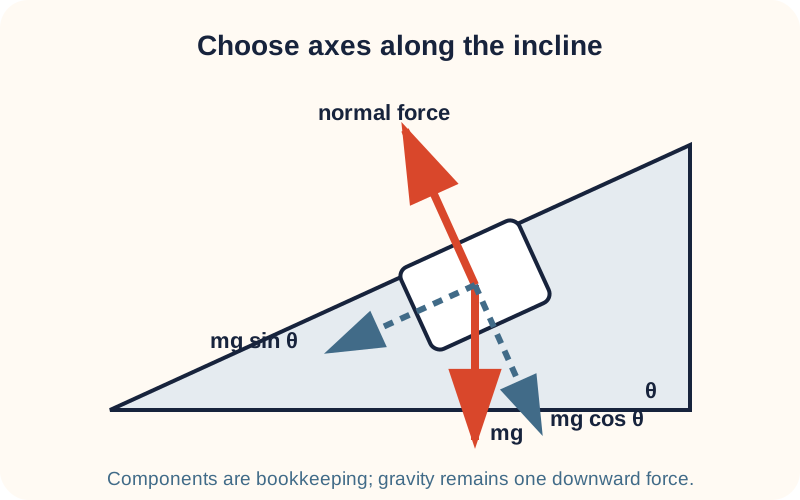
If nothing else accelerates the block perpendicular to the surface, . Components are bookkeeping tools; the gravitational force remains one downward vector.
Two carts connected by a light string share an acceleration magnitude while the string is taut. You may analyze each cart separately to find tension, or treat both carts as one system so their mutual tension forces are internal and cancel from the system equation.
Original example: A cart and a cart move together on a nearly frictionless track. A horizontal force pulls the cart.
For both carts,
For the cart alone, tension is the only horizontal force:
“Moving forward means a forward net force.” Forward velocity can coexist with zero or backward net force.
“Action and reaction cancel.” They act on different objects. Only forces on the same chosen system can cancel in its net force.
“Normal force always equals weight.” It depends on all perpendicular forces and perpendicular acceleration.
“Static friction is always .” It adjusts from zero to a maximum.
Newton's laws become reliable when forces are treated as interactions and the system boundary is explicit. A correct free-body diagram is not decoration—it is the evidence map from which the equations follow.
How does a cart's acceleration depend on net external force and total system mass?
Conduct this investigation under teacher or responsible-adult supervision. Keep the cart path clear, secure the track, use small masses, keep feet away from falling masses, and place a soft catch box beneath the hanging mass. Never suspend fragile or heavy objects. Stop if string, pulley, or track is damaged.
Low-cost alternative: a toy cart, smooth board, washers in a paper cup, string over a rounded edge, and slow-motion phone video.
Simulation alternative: use a teacher-approved force-and-motion simulation. Record the same variables and explain which real effects the simulation omits.
Treat the cart, string, and hanging mass as one system. The hanging weight drives the motion; friction is an external opposing interaction. The tested model is
Transfer mass from the cart to the hanger so total system mass stays approximately constant while driving force changes.
Keep the hanging mass fixed and add mass to the cart.
Acceleration should increase approximately linearly with net external force at fixed total mass and approximately linearly with reciprocal total mass at fixed driving force. Departures from the ideal model should be evaluated using uncertainty and known friction or pulley effects.
| Trial | Cart mass (kg) | Hanging mass (kg) | Total mass (kg) | Driving force (N) | Acceleration (m/s²) | Measurement uncertainty | Notes |
|---|---|---|---|---|---|---|---|
| 1 |
Claim: State whether the observations support and within uncertainty.
Evidence: Cite fitted slopes, intercepts, scatter, and uncertainty—not only visual impressions.
Reasoning: Connect the evidence to and discuss model limitations.
Assign roles such as apparatus manager, timer, recorder, analyst, and safety observer. Provide tactile cart/track inspection, high-contrast markers, a screen-reader-friendly data table, and verbal descriptions of every graph. A student unable to release or retrieve the cart can lead modeling, uncertainty analysis, or CER discussion using shared raw data.
Review the setup, proposed maximum hanging mass, free-body diagrams, and data plan before release trials begin. Retain raw data and the revision history with the final report.
Use the fitted Part A model to predict the acceleration for one safe force value not used in the fit. Test that condition, compare prediction and measurement with uncertainty, and explain whether the model successfully generalized.