Lesson reading
live
15 min
Start with the lesson question, connect the representations, and test the model with evidence.
Inspect the opening phenomenon
Predict what changes, then name the evidence.
Apply in the lab
Name the evidence before reading the answer.
Read only what helps
Then use the lab and recall check.
More when needed
Transcript and resources stay available below.
Course progress
Impulse, Collisions, and System Momentum
Decision challenge
Use the opening example to make a prediction, identify evidence, and explain which model supports it.
Choose right as positive. Predict the sign of each cart's momentum and whether the stuck pair moves left or right.
Predict whether momentum and kinetic energy survive a sticking collision, then check the signed calculation.
Before
Choose right as positive. Predict the sign of each cart's momentum and whether the stuck pair moves left or right.
During
Pause after the two initial momenta appear. Add them with signs, then divide by the combined mass before the result is revealed.
After
Explain why system momentum is conserved while kinetic energy decreases in the sticking collision.
Lesson reading
live
15 min
Video script
draft
Transcript fallback
available
courses/ap-physics-1/modules/04-linear-momentum/lessons/01-impulse-collisions-and-system-momentum/video-transcript.md
Momentum Before and After a Cart Collision
draft
1 hr 30 min
Mastery check
live
7 questions / 15 min
# Accessible transcript: Why Momentum Survives a Crash A crash can destroy kinetic energy—but not necessarily momentum. Put both carts inside one system. During the brief collision, their huge forces are internal and cancel in the system total. Point four kilograms moves right at three meters per second. Point six moves left at one. Signed momentum is one point two minus point six: positive point six kilogram-meter per second. They stick, so divide by their combined one kilogram. Final velocity: point six meters per second right. Quick check: was kinetic energy also conserved? Pause. No. Sticking converts some kinetic energy, while system momentum survives when external impulse is negligible. Learn it free at EduQuest AI. ## Visual description Two labeled carts approach, collide, and stick. A boundary encloses both carts. Blue and coral arrows encode opposing signed momenta. The joined cart moves slowly right. A kinetic-energy symbol dims while the total-momentum indicator remains unchanged. All numerical information is repeated in narration.
Reading lab
Connect the lesson's words, diagrams, graphs, evidence, and equations.
What can we predict about an interaction when external impulse is limited?
Two carts approach each other. One is twice as massive but moves half as fast. Before calculating, decide whether the system's momentum points left, right, or is zero. Then state what additional information you need to predict each cart's final velocity.
A collision may bend bumpers, create sound, and turn kinetic energy into thermal energy. Yet the total momentum of a well-chosen system can remain nearly constant. Momentum lets us predict the before-to-after change without resolving every force during the brief interaction.
For a particle of constant mass,
Momentum has units . Its direction is the velocity direction. A larger object does not automatically have more momentum; mass and velocity both matter.
For a multi-object system,
Choose axes first. In one dimension, right may be positive and left negative. Never add speeds when directions differ.
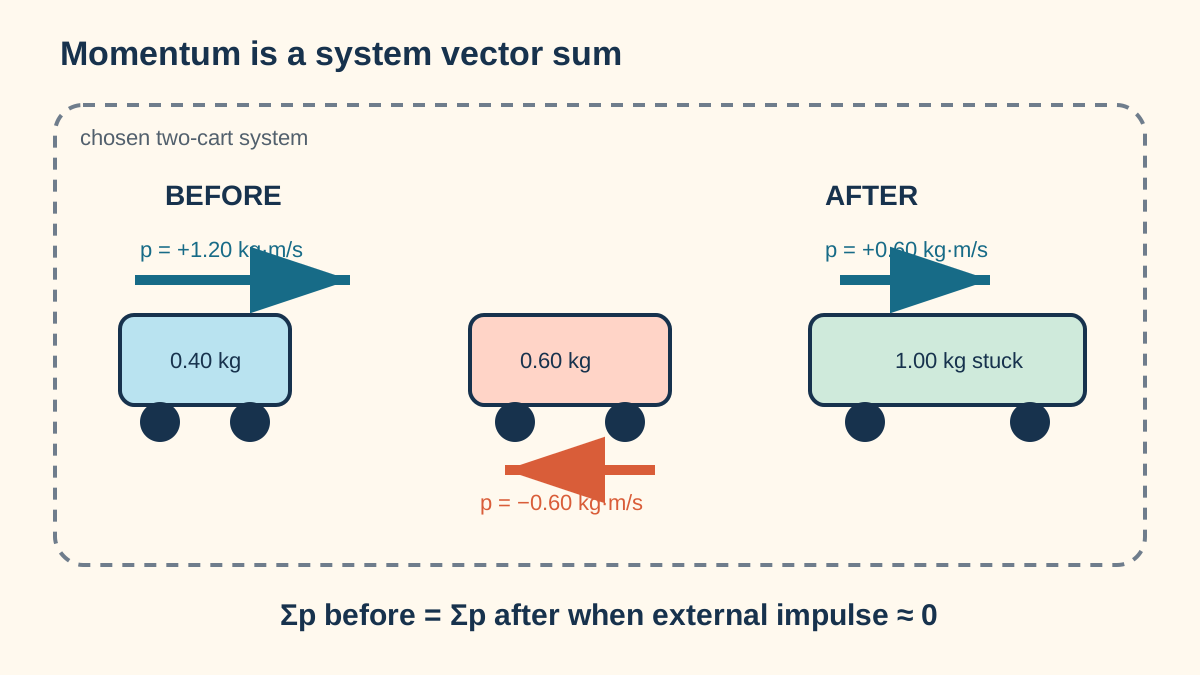
The diagram is equivalent to the statement that the vector sum before equals the vector sum after when external impulse is negligible.
Impulse is the time accumulation of force:
For constant or average net force,
On a net-force-versus-time graph, signed area is impulse. Peak force alone does not determine momentum change.
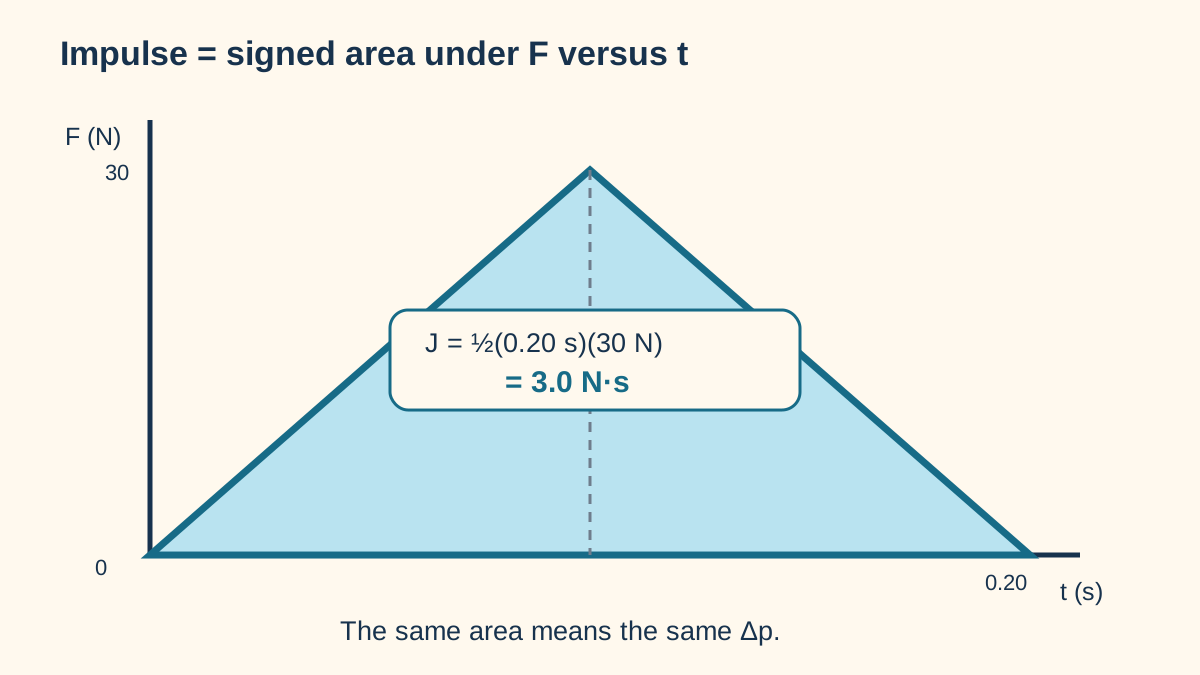
A ball moving at is caught and brought to rest. Its momentum change is
If the catch lasts , the average net force is
If the catcher moves their hands so the same momentum change takes longer, the average force magnitude decreases. The impulse remains .
For a chosen system,
If external impulse is zero or negligible during the interval,
Internal interaction forces occur in Newton's-third-law pairs. Their impulses cancel in the total system momentum, although each object can undergo a large momentum change.
Momentum conservation alone generally cannot determine two unknown final velocities. An elastic collision needs the additional kinetic-energy condition; a sticking collision supplies a shared-velocity condition.
A cart moving right at sticks to a cart moving left at . Neglect external impulse during impact.
The positive result means the joined carts move right. Initial kinetic energy is and final kinetic energy is ; the difference becomes other forms of energy. Momentum conservation does not imply kinetic-energy conservation.
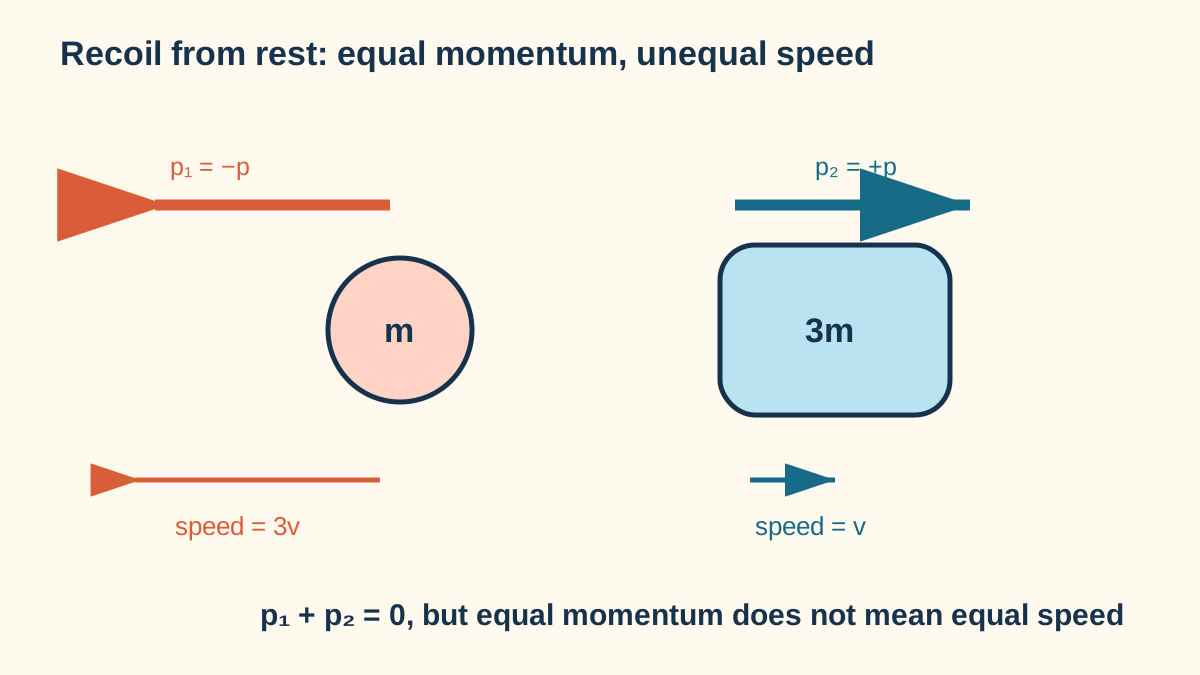
If a system initially at rest separates under internal forces and external impulse is negligible,
\vec p_1+ ec p_2=0.The pieces have equal-magnitude, opposite momenta—not necessarily equal speeds. The less massive piece moves faster.
System momentum relates to center-of-mass velocity:
Internal collisions can radically change individual velocities while the center-of-mass motion changes only through external impulse.
For each scenario, identify the system and interaction interval before choosing “momentum conserved.” Ask:
Momentum conservation is vector conservation:
Choose axes, resolve momentum vectors into components, and keep signs consistent. Kinetic energy is a scalar and does not have and components.
“Momentum is conserved for each object.” Interaction impulses usually change each object's momentum; the total system momentum is the conserved quantity.
“Kinetic energy is conserved in every collision.” It is conserved only in elastic collisions, while total energy is always accounted for in all forms.
“Equal and opposite forces mean equal accelerations.” Third-law forces are equal, but different masses can have different accelerations.
“A larger object always has more momentum.” Momentum depends on both mass and velocity.
Momentum conservation is not a slogan about collisions. It is a consequence of negligible external impulse on a clearly defined system over a stated interval.
How closely is measured system momentum conserved in elastic-like and sticking cart collisions, and how does kinetic-energy behavior differ?
Work under teacher or responsible-adult supervision. Secure and level the track, use low-speed carts and small masses, keep faces and fingers away from bumpers and magnets, install end stops, and keep the travel lane clear. Do not alter spring bumpers or use projectiles. Inspect carts and track before use.
Low-cost alternative: two toy cars on a smooth floor, removable modeling-clay coupler, meterstick markers, and slow-motion video.
Simulation alternative: a teacher-approved collision simulation with exported raw data. Explain which real losses and measurement uncertainties it omits.
Total two-cart momentum should agree before and after within experimental uncertainty when external impulse during the collision is small. Kinetic energy should be closer to conserved for elastic-like trials and decrease more substantially for sticking collisions.
For each trial calculate
and
Make separate claims about momentum and kinetic energy for each collision category. Cite numerical comparisons and uncertainties, then connect them to external impulse and energy transformation.
Offer roles for apparatus safety, release, measurement, data recording, graphing, uncertainty analysis, and oral reporting. Use high-contrast cart markers, tactile track orientation, screen-reader-friendly tables, and verbal graph descriptions. All conclusions can be completed from shared class data without physically operating carts.
Predict the shared final velocity for a new safe sticking-collision condition using only measured initial velocities and masses. Test it once, compare prediction with measurement and uncertainty, and explain any discrepancy.