Lesson reading
live
5 min
Start with the lesson question, connect the representations, and test the model with evidence.
Inspect the opening phenomenon
Predict what changes, then name the evidence.
Apply in the lab
Name the evidence before reading the answer.
Read only what helps
Then use the lab and recall check.
More when needed
Transcript and resources stay available below.
Course progress
Pendulums and Oscillation Energy
Decision challenge
Use the opening example to make a prediction, identify evidence, and explain which model supports it.
Predict whether increasing the pendulum bob mass changes its small-angle period.
Predict the period dependence, track energy through the swing, and test the small-angle model.
Before
Predict whether increasing the pendulum bob mass changes its small-angle period.
During
Pause at the turning point and bottom to identify the dominant energy store at each position.
After
Explain why quadrupling pendulum length doubles its small-angle period.
Lesson reading
live
5 min
Video script
draft
Transcript fallback
available
courses/ap-physics-1/modules/07-oscillations/lessons/02-pendulums-and-oscillation-energy/video-transcript.md
Pendulum Period, Length, and Model Limits
draft
1 hr 15 min
Mastery check
live
7 questions / 18 min
--- lesson_slug: 02-pendulums-and-oscillation-energy duration_seconds: 55 --- # Transcript A heavier pendulum bob does not make the clock run slower. At small angles, the period is two pi times the square root of length over gravity. Mass cancels: more weight comes with proportionally more inertia. At the turning point, speed is zero and energy is gravitational. At the bottom, speed and kinetic energy peak. Total mechanical energy stays constant in the ideal model. But the period formula is a small-angle approximation. A forty-five-degree release takes measurably longer. Pause: quadruple the length. What happens to period? It doubles. Explore the free AP Physics 1 lesson at EduQuest AI.
Reading lab
Connect the lesson's words, diagrams, graphs, evidence, and equations.
Why does pendulum length set the clock while bob mass does not?
Two small-angle pendulums have equal length but different bob masses. Predict which has the longer period, then identify what measurement could disprove your prediction.
For an ideal simple pendulum of length at small angular amplitude,
Mass is absent because both the restoring gravitational effect and inertia scale with mass. Length matters: quadrupling doubles .
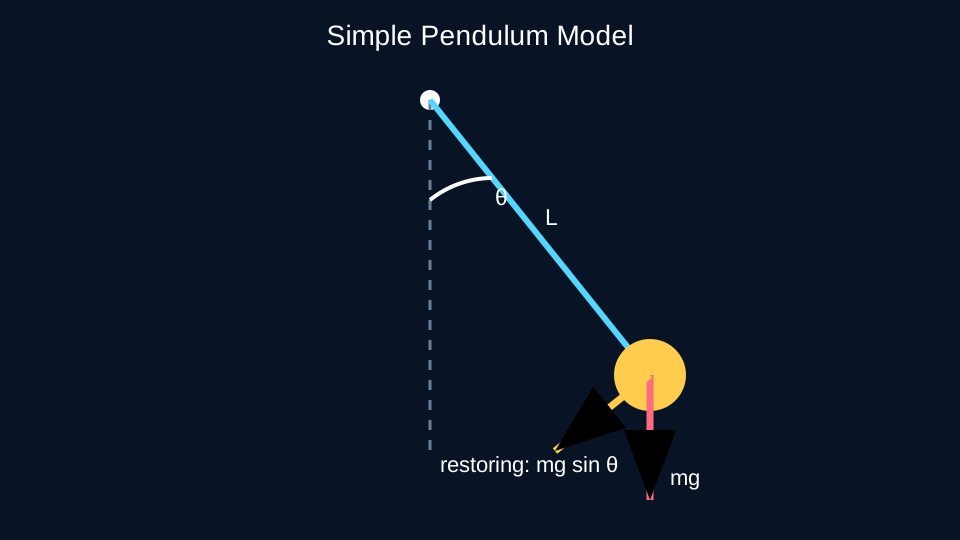
Tangential gravity is . With arc displacement ,
For small angles measured in radians, , so
This has simple-harmonic form with and .
A small-angle pendulum has . With ,
Choosing zero gravitational potential at the bottom, the exact potential energy is
At a turning point, speed is zero and energy is all potential. At the bottom, potential is minimum and speed is maximum. With negligible losses,
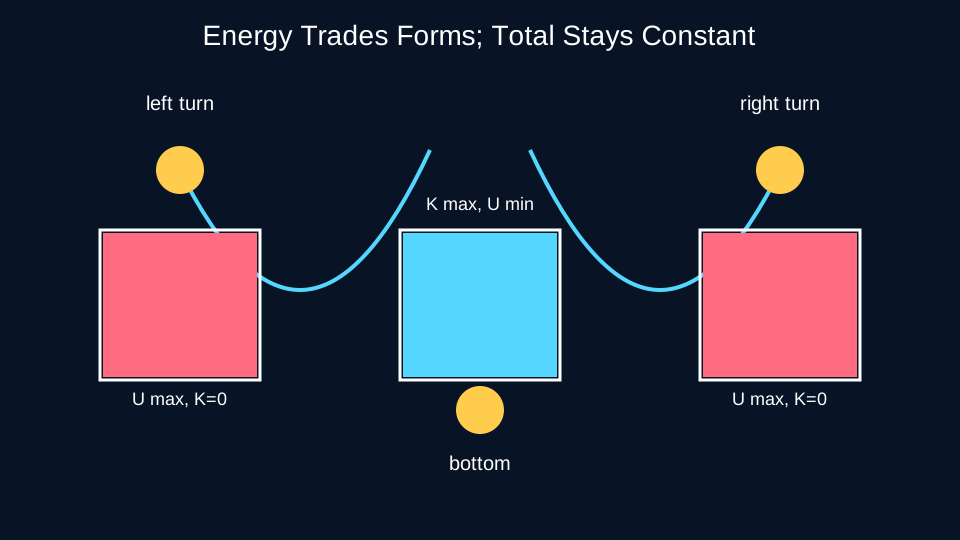
Released from rest at and ,
Mass cancels again.
For ideal SHM, displacement is sinusoidal; velocity is shifted by one-quarter cycle; acceleration points opposite displacement. Kinetic energy and potential energy repeat twice per displacement cycle because they depend on squared quantities.
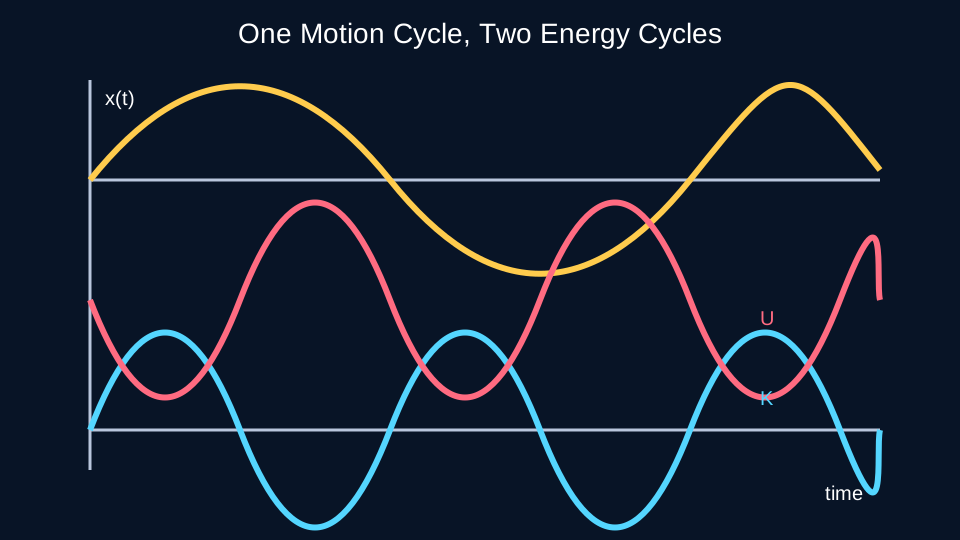
At equilibrium, rank speed, acceleration magnitude, kinetic energy, and potential energy as maximum, minimum, or zero.
Air resistance and pivot friction transfer mechanical energy to thermal energy, reducing amplitude. Weak damping often changes period only slightly while the envelope shrinks. Periodic driving can add energy; resonance occurs when driving frequency is near the system's natural frequency, though damping limits amplitude.
A pendulum's measured period grows as the release angle increases from to . Explain why this does not contradict the small-angle formula and propose a graph that reveals the model's range.
State the system and zero-energy reference, identify whether the small-angle approximation applies, choose force/torque or energy reasoning, preserve radians in the approximation, and compare predictions with uncertainty.
See sources.yaml. All prose, examples, questions, and diagrams are original and do not imply College Board endorsement.
Test the predicted relationship and investigate when release angle changes the measured period.
Work under teacher or responsible-adult supervision. Use a low-mass soft bob securely tied to a stable clamp. Wear eye protection, keep faces and hands outside the swing plane, use small amplitudes for the main investigation, and stop if the support moves or the connector frays. Never use sharp, glass, heavy, or overhead bobs.
Accessible alternative: a partner may release while the learner directs trials and analyzes high-contrast or sonified timing data.
Simulation alternative: use a teacher-approved pendulum simulation and state idealizations.
should be approximately proportional to for small angles. Large release angles should show increasing departure from the small-angle prediction.
Report slope, intercept, uncertainty, residual pattern, and inferred . Discuss reaction time, length reference, amplitude decay, pivot friction, and out-of-plane motion. Use claim-evidence-reasoning to define the supported small-angle range.
Compare two bob masses at equal length and angle. Determine whether any observed difference is statistically meaningful rather than merely nonzero.