Lesson reading
live
10 min
Start with the lesson question, connect the representations, and test the model with evidence.
Inspect the opening phenomenon
Predict what changes, then name the evidence.
Apply in the lab
Name the evidence before reading the answer.
Read only what helps
Then use the lab and recall check.
More when needed
Transcript and resources stay available below.
Course progress
Rotational Energy and Angular Momentum
Decision challenge
Use the opening example to make a prediction, identify evidence, and explain which model supports it.
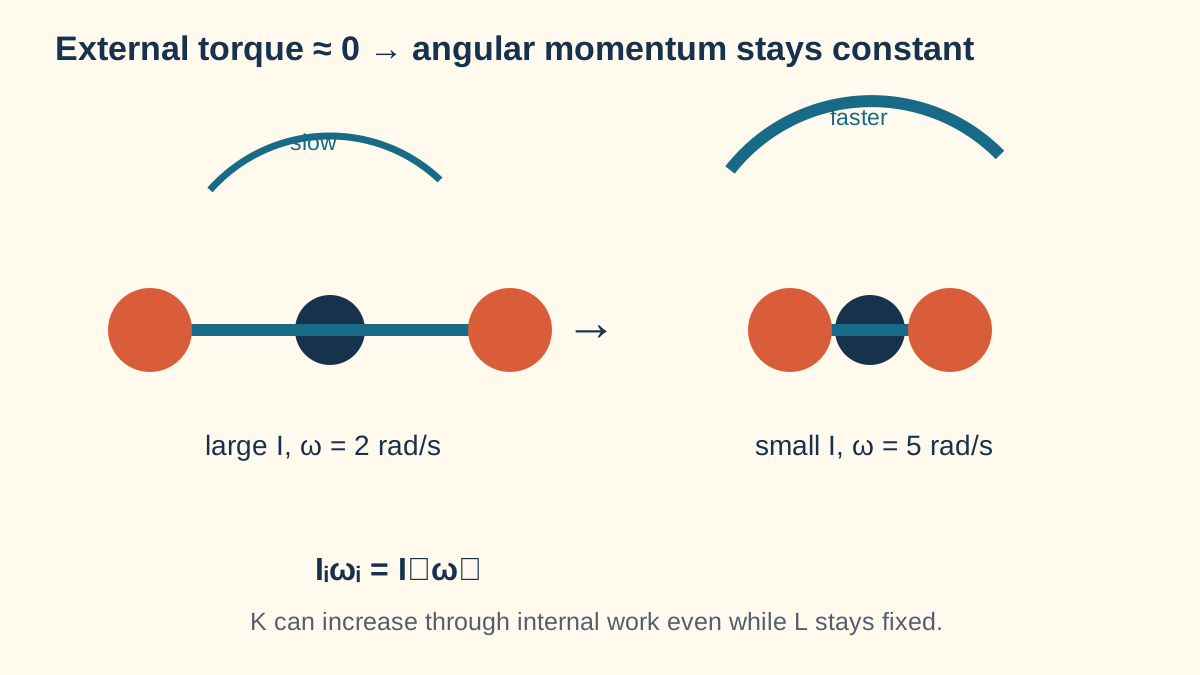
Predict what happens to angular speed when a rotating student pulls two masses inward with negligible external torque.
Predict the final angular speed and decide whether rotational kinetic energy is also conserved.
Before
Predict what happens to angular speed when a rotating student pulls two masses inward with negligible external torque.
During
Pause at 4.0 times 2.0 equals 1.6 times final angular speed. Solve for the final value before it appears.
After
Explain why angular momentum remains constant while rotational kinetic energy increases during the inward pull.
Lesson reading
live
10 min
Video script
draft
Transcript fallback
available
courses/ap-physics-1/modules/06-energy-and-momentum-of-rotating-systems/lessons/01-rotational-energy-and-angular-momentum/video-transcript.md
Rolling Energy and Rotational Inertia
draft
1 hr 30 min
Mastery check
live
7 questions / 15 min
# Accessible transcript: Pull In, Spin Faster How can you spin faster without a motor? On a low-friction stool, pull two masses inward. Your rotational inertia drops. With almost no external torque, angular momentum stays constant: four times two equals one point six times final angular speed. Final angular speed is five radians per second. Quick check: if angular momentum stayed constant, did rotational kinetic energy also stay constant? Pause. No. It increased because pulling inward required internal work. Momentum and energy need separate audits. Learn free at EduQuest AI. ## Visual description A rotating figure begins with masses extended and then pulls them inward. Momentum bars remain equal while angular speed rises from two to five radians per second and an energy meter rises, emphasizing separate conservation tests.
Reading lab
Connect the lesson's words, diagrams, graphs, evidence, and equations.
Which quantities remain useful or conserved in rotating systems?
A student rotates on a low-friction stool while holding two masses. Predict what happens to angular speed when the masses move inward. Then decide whether angular momentum, rotational kinetic energy, both, or neither must remain constant.
Moving mass inward reduces rotational inertia. If external torque is negligible, angular momentum stays constant, so angular speed increases. But rotational kinetic energy can increase because the student does internal work while pulling.
For a rigid body rotating about a fixed axis,
Rotational inertia depends on mass distribution and axis. Angular speed is shared by every point of a rigid body, but linear speed depends on radius:
Points farther from the axis move faster linearly.
A flywheel with rotates at :
Doubling angular speed would quadruple its rotational kinetic energy.
For constant torque through angular displacement,
Instantaneous rotational power is
Torque and energy both use dimensionally, but torque is a signed rotational effect while energy is a scalar measured in joules.
For a rigid body rotating about a fixed symmetry axis,
The general relationship between external torque and angular momentum is
Angular impulse changes angular momentum:
Signed area under a net-external-torque-versus-time graph equals angular-momentum change.
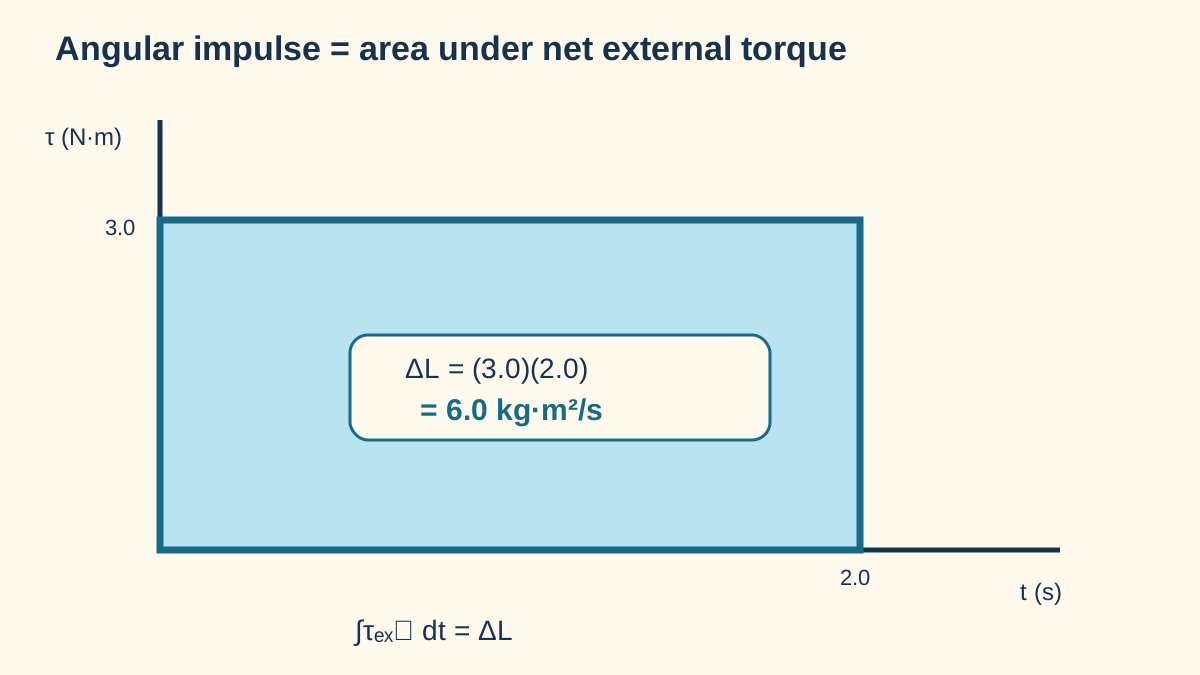
If net external torque is zero or its angular impulse is negligible over the interval,
For a rotating body whose distribution changes,
A rotating system changes from at to . With negligible external angular impulse,
Initial energy is and final energy is . Angular momentum is conserved; kinetic energy increases because internal biochemical energy is transferred by work.
A rolling object's kinetic energy includes translation and rotation:
For rolling without slipping,
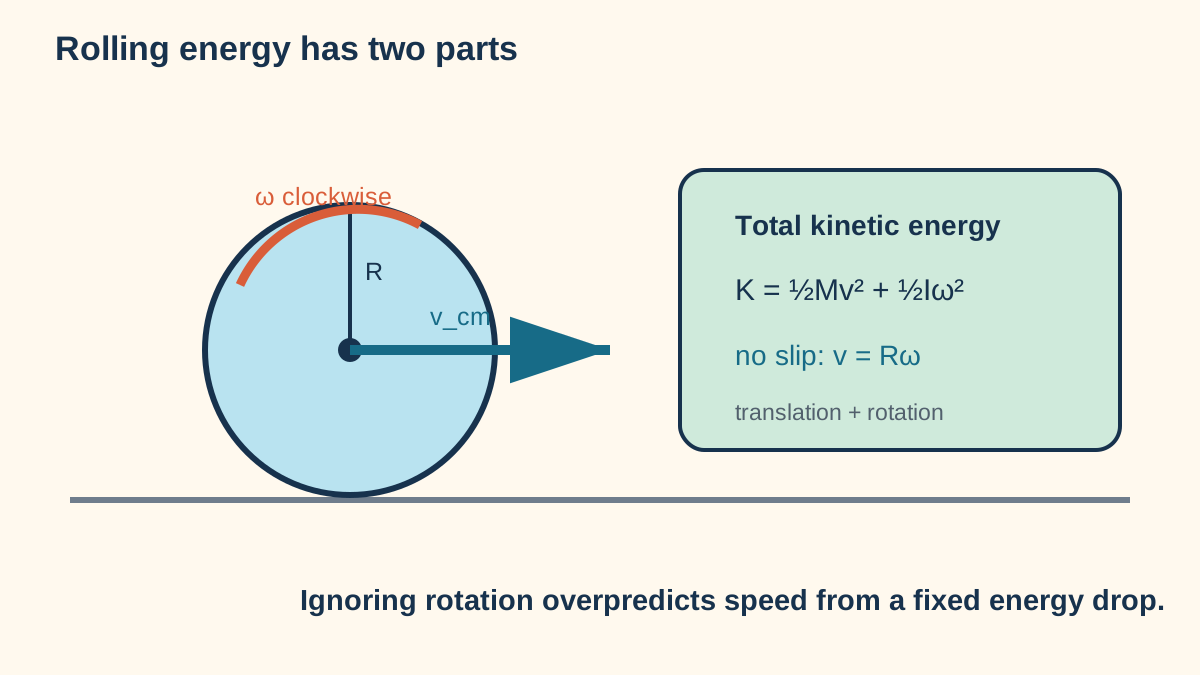
A rolling object does not have only translational energy. Objects with different ratios partition energy differently and can have different accelerations down the same incline.
For a solid cylinder, . At speed without slipping,
One-third of the total kinetic energy is rotational and two-thirds translational.
“Angular momentum is conserved in every rotation.” It changes when net external angular impulse is nonzero.
“If angular momentum is conserved, kinetic energy is conserved.” Internal work can change kinetic energy while remains constant.
“A rolling object has only translational energy.” It also rotates about its center of mass.
“All points on a rigid body have the same linear speed.” They share angular speed; varies with radius.
“Static friction always removes mechanical energy.” In ideal rolling without slipping on a fixed surface, static friction may do no work at the contact point.
Angular momentum is controlled by external angular impulse, while rotational energy is controlled by work and energy transfer. Conservation of one never automatically guarantees conservation of the other.
How does mass distribution affect the acceleration and energy partition of objects rolling without slipping down an incline?
Work under teacher or responsible-adult supervision. Secure a low-angle ramp, use low-mass blunt rolling objects, install a soft catch box, keep the lane and floor clear, and release without pushing. Do not use glass, sharp, motorized, or high-speed objects. Stop if slipping or ramp movement occurs.
Low-cost alternative: sealed cans whose contents do not shift, verified to roll safely, plus phone video.
Simulation alternative: teacher-approved rolling simulation. Export raw data and identify idealizations.
Objects with smaller should accelerate more and reach the bottom sooner under the ideal no-slip model because a smaller fraction of gravitational energy enters rotation.
Use
to predict bottom speed. Compare prediction and measurement with uncertainty.
Claim how mass distribution affected motion. Cite measured speeds/times and uncertainties, then connect evidence to rotational inertia and energy partition.
Provide safety, release, timing, tactile inspection, recording, analysis, and narration roles. Use high-contrast markers, tactile ramp edges, large-print/screen-reader tables, and verbal graph descriptions. Analysis can use shared data without physical handling.
Use measured motion to estimate an object's dimensionless inertia factor , compare it with the expected shape model, and evaluate agreement within uncertainty.