Lesson reading
live
5 min
Start with the lesson question, connect the representations, and test the model with evidence.
Inspect the opening phenomenon
Predict what changes, then name the evidence.
Apply in the lab
Name the evidence before reading the answer.
Read only what helps
Then use the lab and recall check.
More when needed
Transcript and resources stay available below.
Course progress
Circular Motion and Gravitation
Decision challenge
Use the opening example to make a prediction, identify evidence, and explain which model supports it.
Predict the direction of acceleration for an object moving at constant speed around a circle.
Calculate speed and radial acceleration, then identify which real interaction supplies the inward net force.
Before
Predict the direction of acceleration for an object moving at constant speed around a circle.
During
Pause after radius and period appear and calculate the speed before the result is shown.
After
Name the real interaction that supplies the inward net force in one circular-motion example.
Lesson reading
live
5 min
Video script
draft
Transcript fallback
available
courses/ap-physics-1/modules/02-force-and-translational-dynamics/lessons/02-circular-motion-and-gravitation/video-transcript.md
Test Radial Force Versus Speed
draft
1 hr 20 min
Mastery check
live
7 questions / 15 min
# Accessible transcript: Constant Speed, Nonzero Acceleration Constant speed does not mean zero acceleration. In uniform circular motion, the velocity arrow keeps turning, so acceleration points toward the center. At radius point eight meters and period two seconds, speed is two pi r over T: two point five one meters per second. Radial acceleration is v squared over r: seven point nine meters per second squared inward. Quick check: is centripetal force a new force to add? Pause. No. It is the inward net force supplied by real interactions like tension, friction, or gravity. Learn free at EduQuest AI. ## Visual description A marker travels around a circle with tangent velocity arrows and inward acceleration arrows. A numerical radius-and-period example calculates speed and radial acceleration, followed by real-force icons for tension, friction, and gravity.
Reading lab
Connect the lesson's words, diagrams, graphs, evidence, and equations.
How can an object accelerate continuously while its speed remains constant, and what interaction keeps an orbit curved?
A ball moves counterclockwise around a circle at constant speed. At the rightmost point, draw its velocity and acceleration vectors. Then list the actual forces that might produce the acceleration.
In uniform circular motion, velocity changes direction every instant. Acceleration points toward the circle's center even when speed is constant.
For radius and speed ,
With period ,
Velocity is tangent to the path; radial acceleration points inward and is perpendicular to velocity in uniform circular motion.
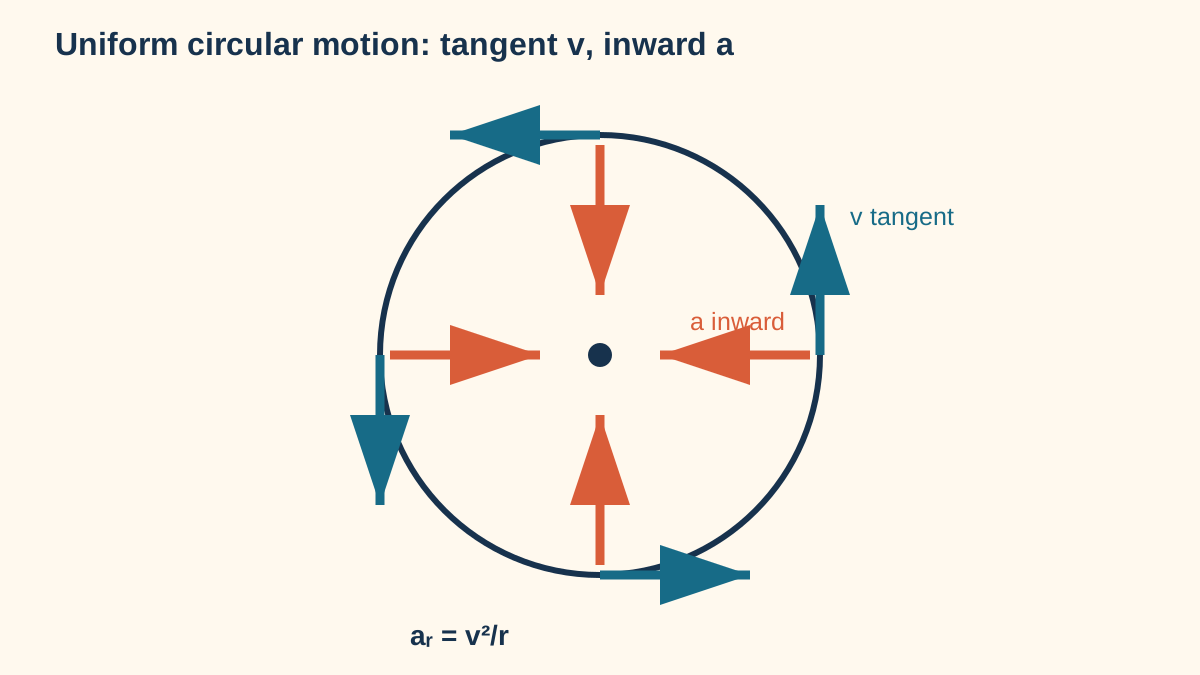
A marker moves in a circle of radius with period :
Newton's second law radially is
Do not add a new force labeled “centripetal” to a free-body diagram. Tension, gravity, friction, normal force, or a combination supplies the inward net force.
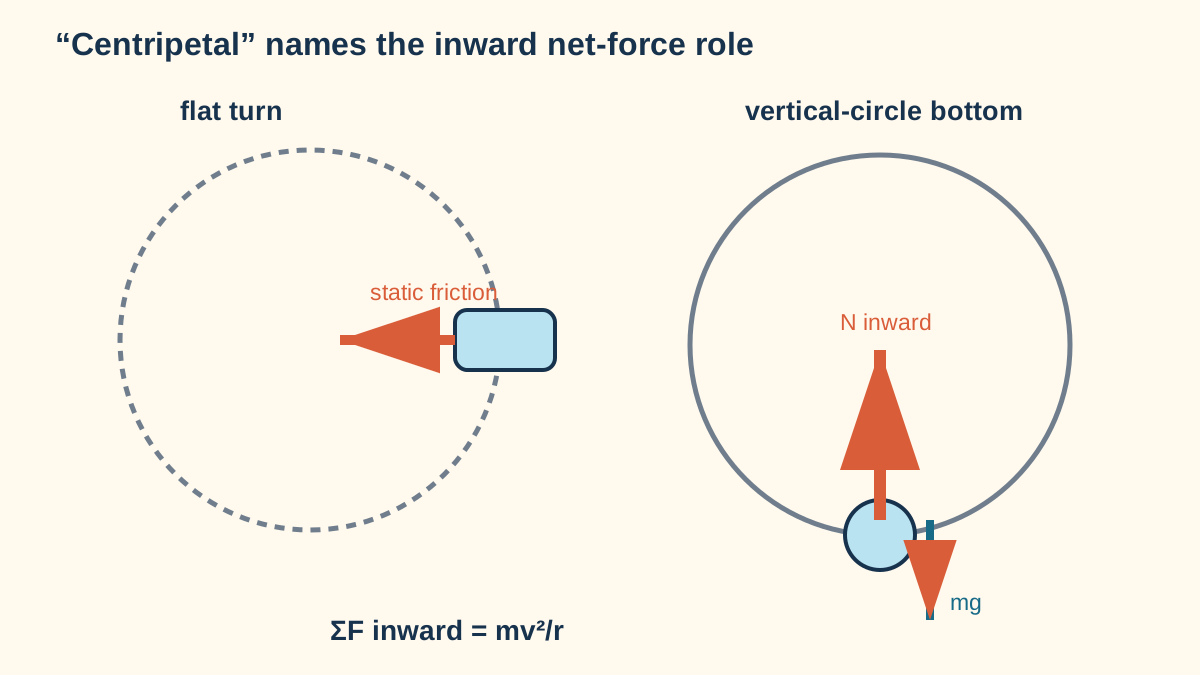
For a car turning on a flat road without slipping, static friction points toward the center:
Since , the ideal maximum speed is .
At the bottom of a vertical circle, inward is upward:
At the top, inward is downward. Radial signs must follow the local inward direction.
Two pointlike or spherically symmetric masses attract with magnitude
is center-to-center separation. The gravitational field due to mass is
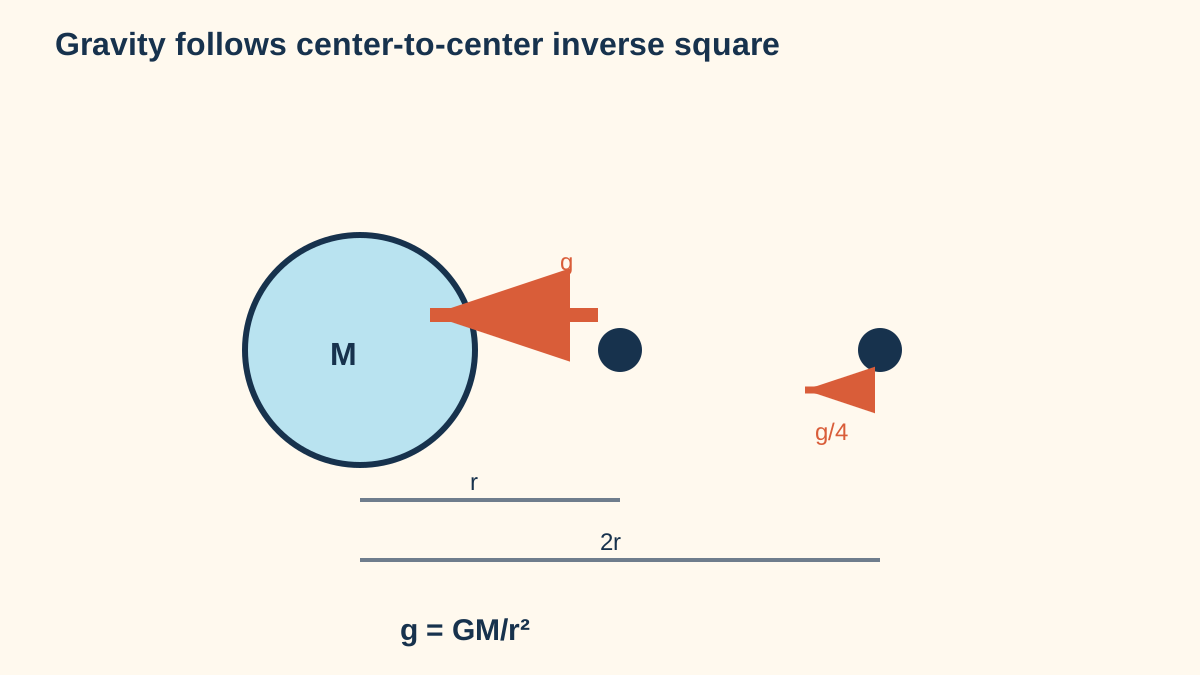
Doubling distance from the center reduces field magnitude to one-fourth.
For a small satellite in a circular orbit around mass , gravity supplies radial net force:
Thus
Satellite mass cancels. Higher circular orbits have lower speed but longer period.
If orbital radius becomes four times larger around the same central mass, speed becomes one-half and period becomes times larger.
Scale reading is usually a normal force, not gravitational force. In orbit, astronauts and spacecraft are both freely falling; gravity is not zero. Their apparent weight is near zero because support force is near zero.
“Constant speed means no acceleration.” Direction change produces radial acceleration.
“Centripetal force is an extra force.” It names the inward net force requirement.
“Circular motion needs an outward force.” In an inertial frame, the net force is inward.
“Astronauts float because gravity is absent.” They float because spacecraft and occupants fall together.
“Higher orbit means faster satellite.” Higher circular orbit means lower speed and longer period.
Circular motion requires inward acceleration supplied by real interactions. Gravity can provide that inward net force, producing continuous free fall around a central body.
For fixed mass and radius, does inward force vary with speed squared as ?
Teacher supervision is required. Use a commercial centripetal-force apparatus or a securely enclosed horizontal rotating system. Wear eye protection if required, inspect all connections, keep the rotation zone clear, use low masses/speeds, and never rotate objects overhead or toward people. Stop for vibration, fraying, looseness, or unstable motion.
Low-cost alternative: use teacher-provided prerecorded data from a safe apparatus rather than an open hand-spun setup.
Simulation alternative: approved circular-motion simulation with exported raw data and stated idealizations.
should be linear in with slope near and intercept consistent with zero within uncertainty.
Claim whether evidence supports . Cite fit, uncertainty, and residual pattern, then connect evidence to radial Newton's second law.
Offer safety, measurement, timing, data, graphing, uncertainty, and narration roles. Use high-contrast/tactile markers and screen-reader tables. Learners may analyze shared or simulated data without operating rotation equipment.
Use the fitted model to predict force at one new approved speed, test once, and compare within uncertainty.