Lesson reading
live
50 min
Start with the lesson question, connect the representations, and test the model with evidence.
Inspect the opening phenomenon
Predict what changes, then name the evidence.
Apply in the lab
Name the evidence before reading the answer.
Read only what helps
Then use the lab and recall check.
More when needed
Transcript and resources stay available below.
Course progress
Motion and Degrees of Freedom
Decision challenge
Use the opening example to make a prediction, identify evidence, and explain which model supports it.
Predict whether three configuration DOF guarantee three independent motion commands.
Before
Predict whether three configuration DOF guarantee three independent motion commands.
During
Track the difference between x-y-yaw and v-omega.
After
Explain reachable later versus movable now.
Lesson reading
live
50 min
Video script
draft
Transcript fallback
available
courses/ai-robotics/modules/03-motion-frames-and-kinematics/lessons/02-motion-and-degrees-of-freedom/video-transcript.md
Reachable Later, Movable Now Lab
draft
25 min
Mastery check
live
6 questions / 10 min
# Transcript This rover has three degrees of freedom. So why can’t it move directly sideways? Degrees of freedom count the independent values needed to specify configuration. On a flat floor, those are x, y, and yaw. But configuration is not instantaneous motion. Ideal differential-drive wheels command forward speed v and turning rate omega. They do not command sideways slip. So three configuration degrees of freedom does not mean three independent velocity commands, and degrees of freedom is not actuator count. Can the rover still reach a point to its side? Yes. It can turn, drive, and turn again. Remember: reachable later is different from movable now. Explore the full lesson on EduQuest.
Reading lab
Connect the lesson's words, diagrams, graphs, evidence, and equations.
Opening challenge: A rover can eventually reach any pose on a flat floor, so why can it not move directly sideways right now?
A robot's configuration is the smallest set of numbers needed to specify where all its rigid parts are. The set of possible configurations is configuration space, or C-space. Its dimension is the robot's number of degrees of freedom (DOF).
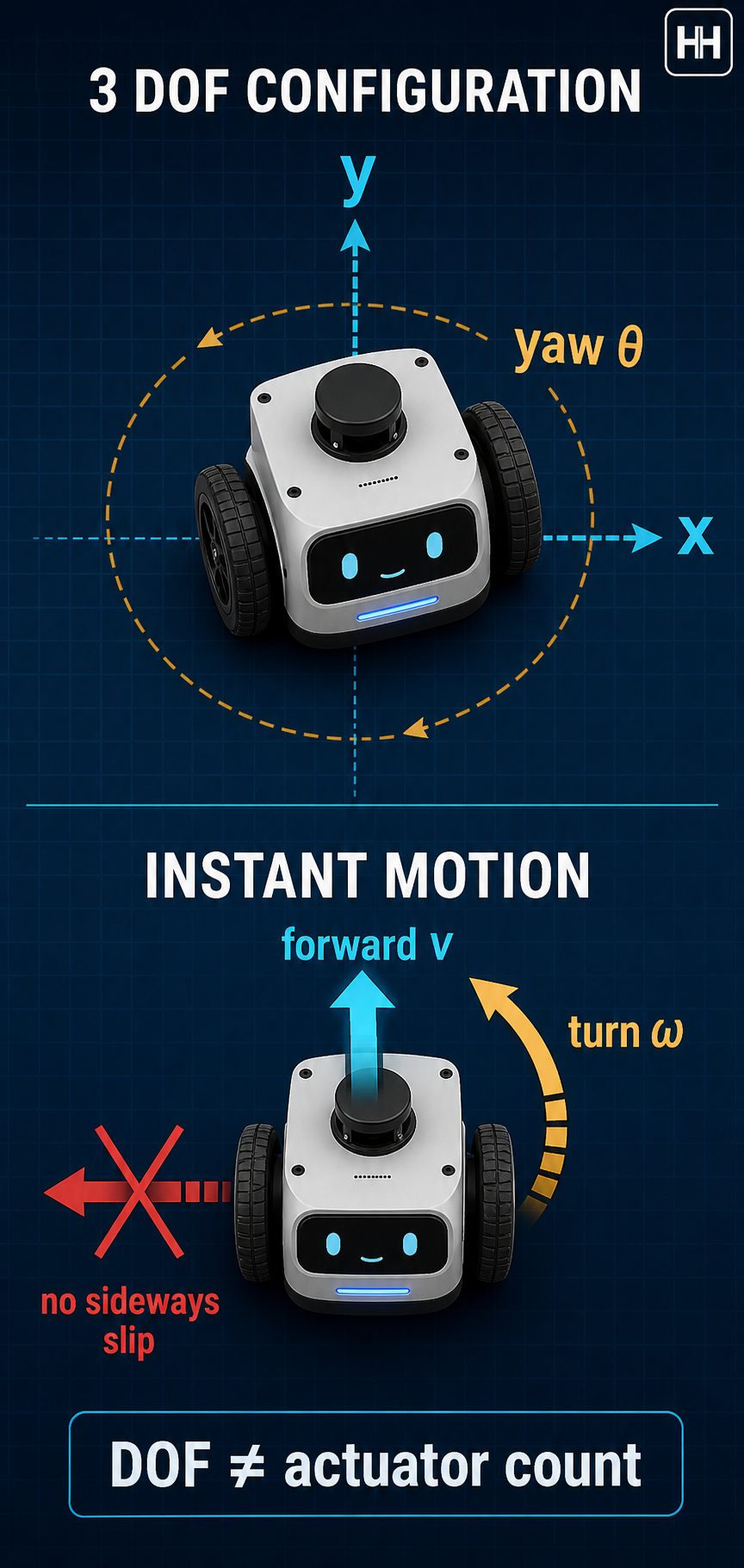
A free rigid body in a plane has three DOF: position , position , and orientation . In three-dimensional space it has six: three translations and three rotations. Constraints remove independent choices. A hinge permits one rotation; a slider permits one translation.
Configuration answers where. Velocity answers how fast and in which direction configuration is changing. Acceleration answers how velocity is changing. Units expose mistakes: position may be metres or radians, velocity metres per second or radians per second, and acceleration metres per second squared or radians per second squared.
For a planar rover:
It has three configuration DOF. A differential-drive rover normally commands forward speed and yaw rate . With ideal no-side-slip wheels:
At , it cannot command an instantaneous world- slide. Yet by driving and turning, it can reach different positions later. Reachable eventually is not the same as movable directly now.
DOF counts independent configuration coordinates; actuators count independent control inputs in the chosen model. A system is underactuated when its available inputs cannot independently command every modeled DOF. The rover has three configuration DOF but two usual inputs, and . Wheel constraints couple the motion.
Joint limits reduce range but do not normally change DOF inside that range. Locking a joint adds a constraint and can reduce DOF. Singular configurations can temporarily remove useful motion directions even when the mechanism's nominal DOF count is unchanged.
A rover starts at and executes , for two seconds under an ideal constant-velocity model. It reaches . If it instead commands , for one second, it remains at while yaw becomes . Combining timed forward and turning segments produces sideways displacement without sideways slip.
Sources are linked and paraphrased. The teaching visual is an original HH asset.
Separate configuration DOF from instantaneous allowed velocity using a paper or spreadsheet rover.
No hardware or paid software is required. Represent state as and commands as .
The rover reaches a point to its side through a sequence, but cannot produce instantaneous sideways slip. Its configuration uses three values while its usual command uses two.
Add a maximum speed and yaw-rate limit. Find the shortest legal command sequence you can construct to reach , then explain which constraint controls the completion time.
Use a screen-reader-friendly table with time, x, y, yaw, v, and omega columns. This simulation-first activity has no moving hardware.