Lesson reading
live
1 hr
Start with the lesson question, connect the representations, and test the model with evidence.
Inspect the opening phenomenon
Predict what changes, then name the evidence.
Apply in the lab
Name the evidence before reading the answer.
Read only what helps
Then use the lab and recall check.
More when needed
Transcript and resources stay available below.
Course progress
Proportional Control and Stability
Decision challenge
Use the opening example to make a prediction, identify evidence, and explain which model supports it.
Predict whether the largest gain will produce the best complete response.
A larger gain produces a stronger correction, but the full response determines whether it is useful.
Before
Predict whether the largest gain will produce the best complete response.
During
Track error, requested command, applied command, overshoot, and settling.
After
Choose one gain and cite two response measures.
Lesson reading
live
1 hr
Video script
draft
1080x1920
Transcript fallback
available
courses/ai-robotics/modules/05-feedback-and-control/lessons/02-proportional-control-and-stability/video-transcript.md
Tune a Proportional Heading Controller
draft
30 min
Mastery check
live
7 questions / 10 min
# Transcript — Can More Gain Make a Robot Worse? A rover must turn to ninety degrees. Proportional control multiplies signed error by gain: u equals K p times e. More gain means a stronger command for the same error, but the actuator may clamp that request. Low gain can be slow. Moderate gain can settle efficiently. Excessive gain may overshoot, oscillate, or stay saturated—depending on the robot and delay. Choose gain from the complete response: rise, overshoot, settling, limits, and disturbance recovery. Which trace would you defend, and what evidence supports it?
Reading lab
Connect the lesson's words, diagrams, graphs, evidence, and equations.
A rover faces 0° and must turn to 90°. A tiny correction is safe but slow. A strong correction moves quickly—but may carry the rover past the target and send it back again.
Predict: If the rover keeps overshooting left and right, should you always increase its gain?
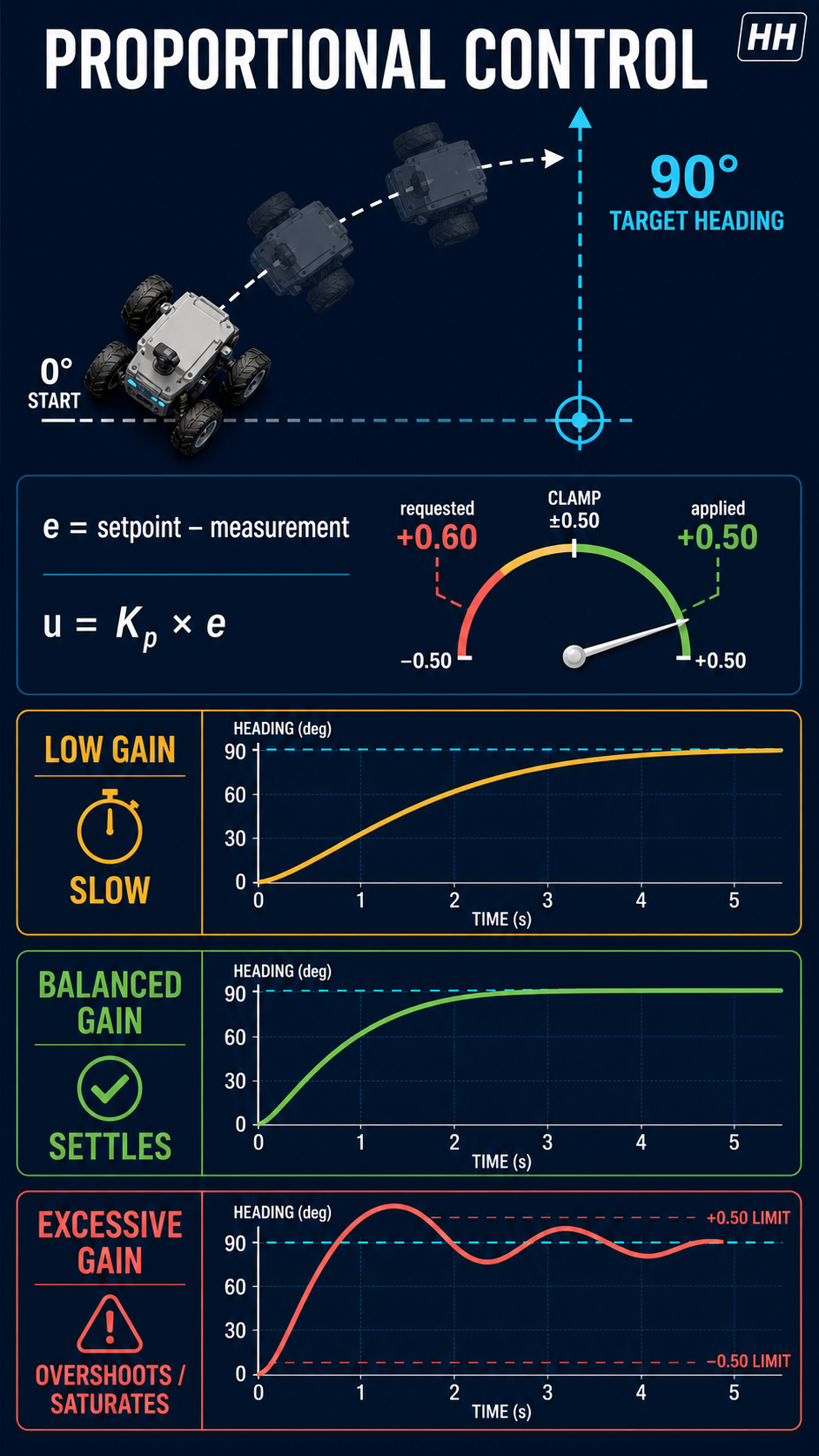
Define signed error:
e = setpoint - measurement
Then compute the controller output:
u = Kp × e
Kp is proportional gain. It converts error units into command units. With a 90° setpoint, a 60° measurement, and Kp = 0.02 command/degree:
e = 90° - 60° = +30°
u = 0.02 × 30 = +0.60
The positive sign tells the rover which way to turn. The magnitude tells it how strongly.
Suppose the motor command must remain between −0.50 and +0.50. The controller asks for +0.60, but the applied command is:
u_applied = clamp(+0.60, -0.50, +0.50) = +0.50
This is saturation. The controller equation and physical command are not always identical. Any evaluation that ignores command limits can recommend impossible behavior.
| Evidence | Question |
|---|---|
| Rise time | How quickly does the response approach the target? |
| Overshoot | How far does it pass the target? |
| Settling | When does it enter and remain inside tolerance? |
| Steady-state error | What error remains after transients fade? |
| Saturation time | How long is the actuator pinned at a limit? |
| Boundedness | After a disturbance, do error and command remain bounded? |
A low gain often gives a slow response. A moderate gain may balance speed and overshoot. An excessive gain can amplify delayed corrections, cause repeated overshoot, keep the actuator saturated, or destabilize some plants. These are tendencies, not universal guarantees: the plant, sampling, friction, delay, and limits matter.
Three simulated runs use the same rover, target, starting angle, update period, and command limit.
Kp = 0.005: small commands; slow approach; little overshoot.Kp = 0.02: faster approach; bounded correction; settles inside tolerance.Kp = 0.08: reaches the target quickly but overshoots, reverses, and spends more time saturated.The defensible choice is not “the biggest gain.” It is the gain whose full response meets the task constraints.
For this lesson, call an equilibrium locally stable when a small disturbance produces a response that remains bounded and returns toward the target. One successful crossing of 90° does not establish stability. Inspect what happens afterward and repeat with a disturbance.
At a setpoint of 90°, the measured heading is 100°, and Kp = 0.03. What are the signed error and unsaturated command?
Answer after calculating: e = -10°, so u = -0.30. The command reverses direction because the rover passed the target.
Proportional control maps signed error to command through u = Kp e. Gain should be selected from response evidence—speed, overshoot, settling, residual error, saturation, and boundedness—under realistic limits and disturbances.
Compare three proportional gains in a hardware-free heading simulation and defend one using response evidence.
lab-worksheet.csvdt = 0.2 serror = 90 - headingraw_command = Kp × errorcommand = clamp(raw_command, -0.50, +0.50)turn_rate_next = 0.75 × turn_rate + 24 × commandheading_next = heading + 0.2 × turn_rate_nextKp = 0.005, 0.02, and 0.08.Low gain should respond slowly. Moderate gain should usually offer a better speed/overshoot tradeoff in this illustrative model. High gain should demand more saturated effort and can oscillate. Exact values depend on rounding.
Use the supplied worksheet and compare the precomputed trend descriptions if graphing is inaccessible. Report direction, peak, settling, and saturation in words.
Repeat the comparison with a different inertia factor or command limit. Explain whether the same gain remains defensible and which response measure changed most.