Lesson reading
live
14 min
Start with the lesson question, connect the representations, and test the model with evidence.
Inspect the opening phenomenon
Predict what changes, then name the evidence.
Apply in the lab
Name the evidence before reading the answer.
Read only what helps
Then use the lab and recall check.
More when needed
Transcript and resources stay available below.
Course progress
Rates, Mechanisms, and Catalysis
Decision challenge
Use the opening example to make a prediction, identify evidence, and explain which model supports it.
Predict whether the overall balanced coefficients determine the rate-law exponents.
Rate-law exponents come from evidence; catalysts change pathways, not equilibrium constants.
Before
Predict whether the overall balanced coefficients determine the rate-law exponents.
During
Track controlled concentration changes, rate factors, inferred orders, and the catalyst distinction.
After
Explain why a valid mechanism must match both the overall equation and experimental rate law.
Lesson reading
live
14 min
Video script
draft
Transcript fallback
available
courses/ap-chemistry/modules/05-kinetics/lessons/01-rates-mechanisms-and-catalysis/video-transcript.md
Evidence-Based Rate Law Investigation
approved
1 hr 30 min
Mastery check
live
6 questions / 15 min
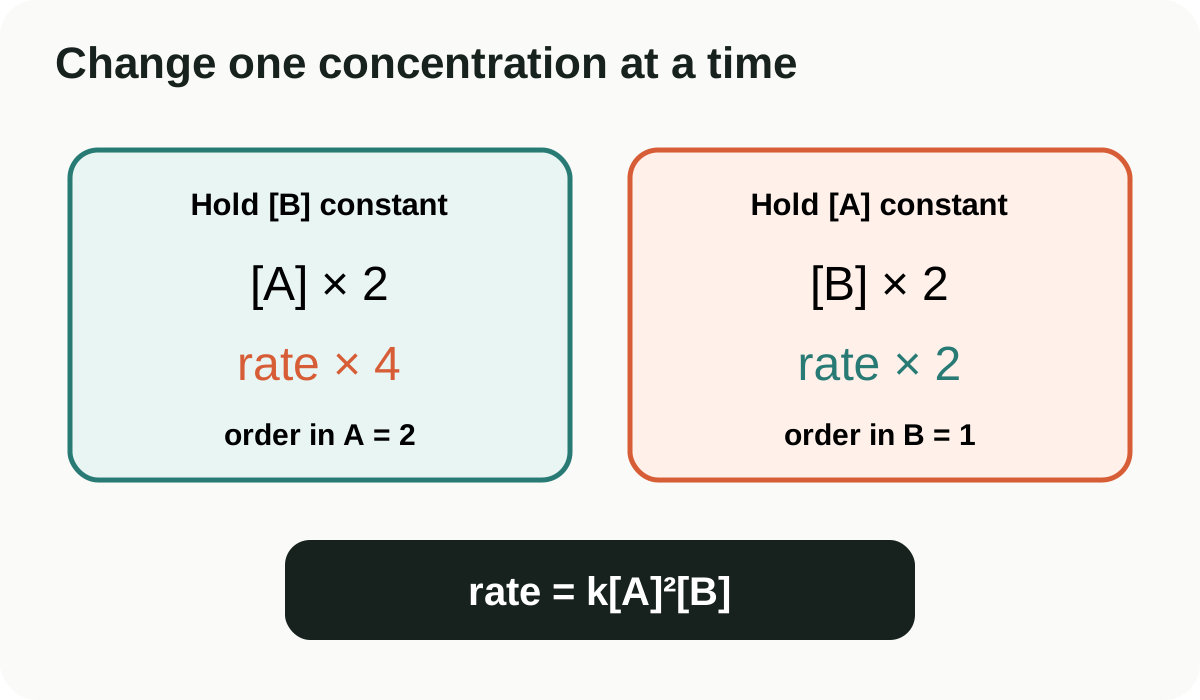
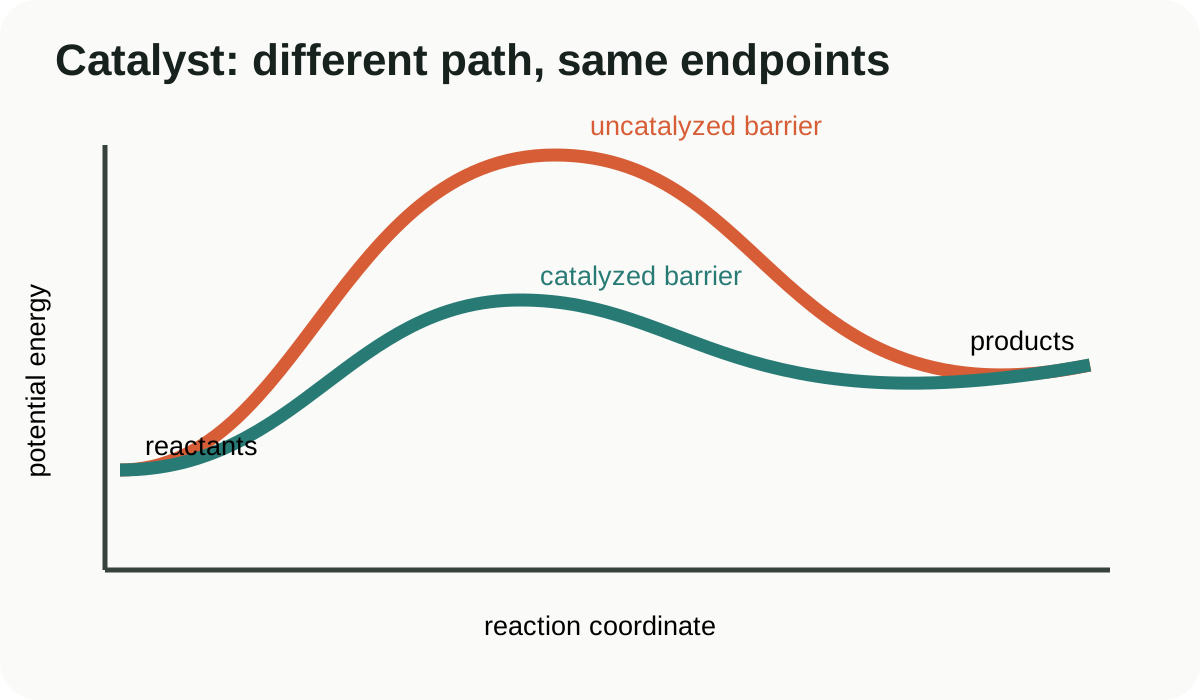
Can a balanced equation tell you the rate law? Usually, no. Watch the evidence. Doubling concentration A makes the initial rate four times larger, so the reaction is second order in A. Then doubling B doubles the rate, so it is first order in B. The experimental law is rate equals k times A squared times B. Overall coefficients describe stoichiometry, not automatically kinetics. A mechanism is credible only if its steps sum to the overall reaction and predict the observed law. Quick check: can a catalyst change the equilibrium constant? No. It lowers the activation barrier for an alternative pathway and speeds both directions, so equilibrium is reached faster without changing its position. Learn the full kinetics evidence chain free at EduQuest AI.
Reading lab
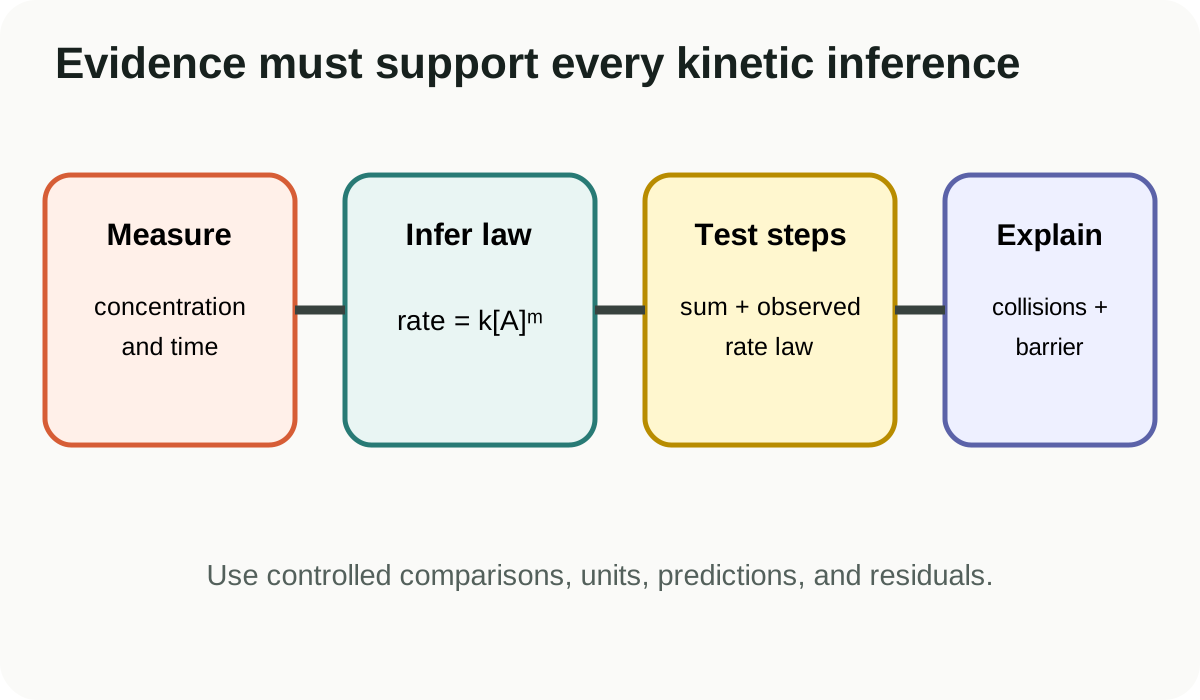
Connect the lesson's words, diagrams, graphs, evidence, and equations.
What evidence reveals how quickly a reaction proceeds, which molecular events control it, and how a catalyst changes the pathway?
For , an average disappearance rate is
The negative sign makes the reported rate positive when reactant concentration decreases. For a general balanced equation , a single reaction rate accounts for coefficients:
Rates depend on collision frequency, collision energy, orientation, and the molecular pathway—not merely whether a balanced equation exists.
A common empirical law is
Orders and are determined from controlled data. They are not generally copied from overall equation coefficients.
| Trial | (M) | (M) | Initial rate (M s) |
|---|---|---|---|
| 1 | 0.100 | 0.100 | |
| 2 | 0.200 | 0.100 | |
| 3 | 0.200 | 0.200 |
Trials 1→2 double while holding constant; rate quadruples, so . Trials 2→3 double and rate doubles, so . Thus
Using trial 1,
Units of depend on overall order.
Linear forms help distinguish common single-reactant laws:
For a first-order process, and does not depend on starting concentration. A straight-looking graph alone is insufficient: inspect axes, units, residuals, and range.
A proposed sequence of elementary steps must:
For an elementary step, molecularity can justify the step's concentration dependence. Do not apply overall coefficients as orders unless the overall reaction is itself an elementary event. An intermediate is produced in one step and consumed in another; a catalyst is consumed and later regenerated.
A catalyst supplies an alternative mechanism with a lower activation-energy barrier. At the same temperature, a larger fraction of collisions can reach the transition region, increasing both forward and reverse rates. A catalyst does not change , , or the equilibrium constant, and it does not change the equilibrium composition; it helps equilibrium be reached faster.
Increasing temperature changes the molecular energy distribution and the rate constant. The Arrhenius relationship is
A linear plot of versus has slope when the model applies.
Determine an empirical rate relationship for an instructor-approved clock or color-change reaction and evaluate uncertainty in the timing signal.
Complete only under qualified instructor supervision using an approved local procedure and current SDS documents. Wear splash goggles, apron, closed-toe shoes, and locally required gloves. Use microscale, dilute reagents selected by the instructor; never mix household chemicals or improvise concentrations. Avoid ingestion and skin/eye contact. For exposure, rinse and use the eyewash for at least 15 minutes while notifying the instructor. Stop for unexpected heating, fumes, or spills and follow the site's emergency plan. A supplied-data alternative supports accessibility but does not replace required supervised AP laboratory work.
Controlled concentration changes produce reproducible rate changes from which empirical orders can be estimated. The proposed law should predict a withheld trial within experimental uncertainty; endpoint subjectivity and mixing delay commonly limit precision.
Design a temperature series that keeps concentrations constant and uses versus to estimate an activation energy.
Collect all reaction mixtures in instructor-designated containers according to reagent-specific SDS and institutional rules; do not drain-dispose without explicit authorization. Provide color-independent sensors, video timing, tactile/large-print instructions, seated work, or a supplied trial dataset while retaining prediction, modeling, and uncertainty analysis.