Lesson reading
live
14 min
Start with the lesson question, connect the representations, and test the model with evidence.
Inspect the opening phenomenon
Predict what changes, then name the evidence.
Apply in the lab
Name the evidence before reading the answer.
Read only what helps
Then use the lab and recall check.
More when needed
Transcript and resources stay available below.
Course progress
Dynamic Equilibrium, Q, K, and Response
Decision challenge
Use the opening example to make a prediction, identify evidence, and explain which model supports it.
Predict the net direction when Q is smaller than K.
Compare the current reaction quotient with the equilibrium constant to predict net direction.
Before
Predict the net direction when Q is smaller than K.
During
Track whether Q must rise or fall to equal K.
After
Explain why a catalyst changes the time to equilibrium but not K.
Lesson reading
live
14 min
Video script
draft
Transcript fallback
available
courses/ap-chemistry/modules/07-equilibrium/lessons/01-dynamic-equilibrium-q-k-and-response/video-transcript.md
A Reversible Color Equilibrium
draft
1 hr
Mastery check
live
6 questions / 15 min
# Dynamic Equilibrium: Q versus K Equilibrium does not mean stopped. It means the forward and reverse reaction rates are equal, so concentrations remain constant while particles keep reacting. To predict the next net change, calculate Q using the same expression as K. If Q is less than K, the mixture makes products. If Q is greater than K, it makes reactants. If Q equals K, it is at equilibrium. Adding a catalyst gets the system to equilibrium faster, but changes neither K nor the equilibrium composition. Remember: direction comes from comparing Q with K, not from guessing which side looks crowded. Retrieval pause: if extra product makes Q greater than K, which direction follows? Net reverse reaction. Continue the free AP Chemistry lesson at EduQuest.
Reading lab
Connect the lesson's words, diagrams, graphs, evidence, and equations.
How can a mixture keep reacting while its macroscopic composition remains constant?
For a reversible reaction, equilibrium occurs when the forward and reverse reaction rates are equal. Both reactions continue. Constant concentrations do not imply equal concentrations; they imply no net macroscopic change.
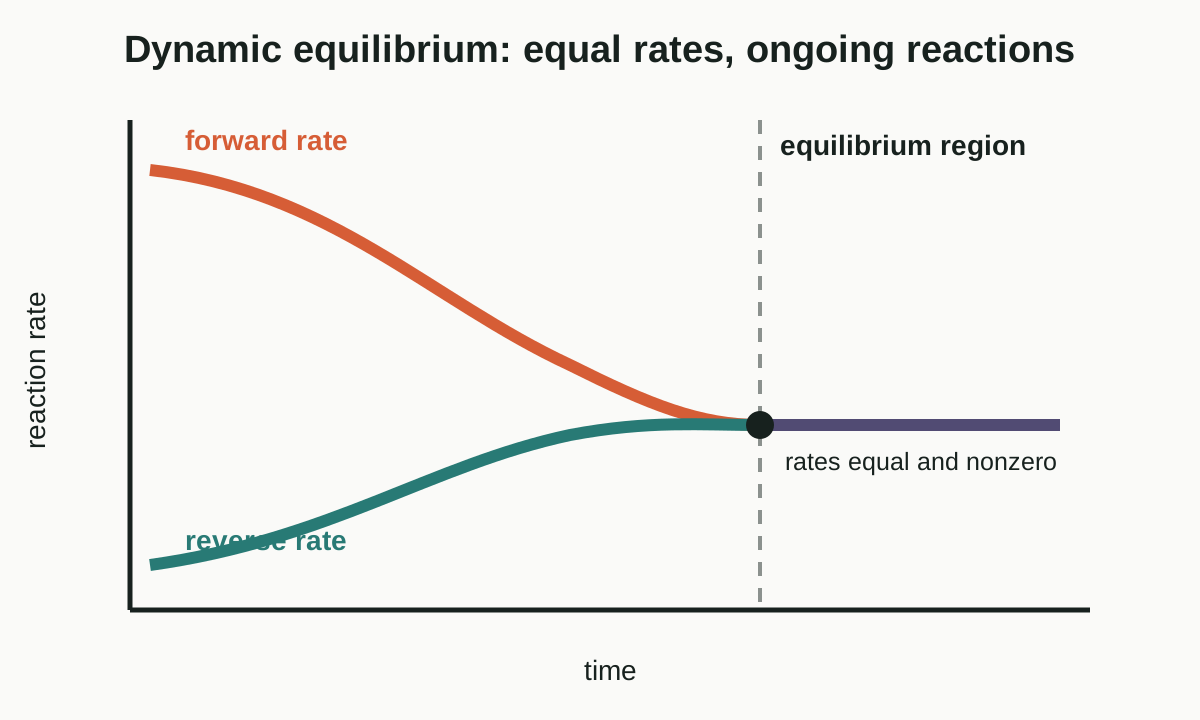
For , Pure solids and pure liquids are omitted because their activities are effectively constant. Gases may be represented with partial pressures in .
The reaction quotient has the same algebraic form as , but uses current, not necessarily equilibrium, values.
This comparison predicts direction, not speed. A very slow system can have , and a catalyst can speed its approach without changing .
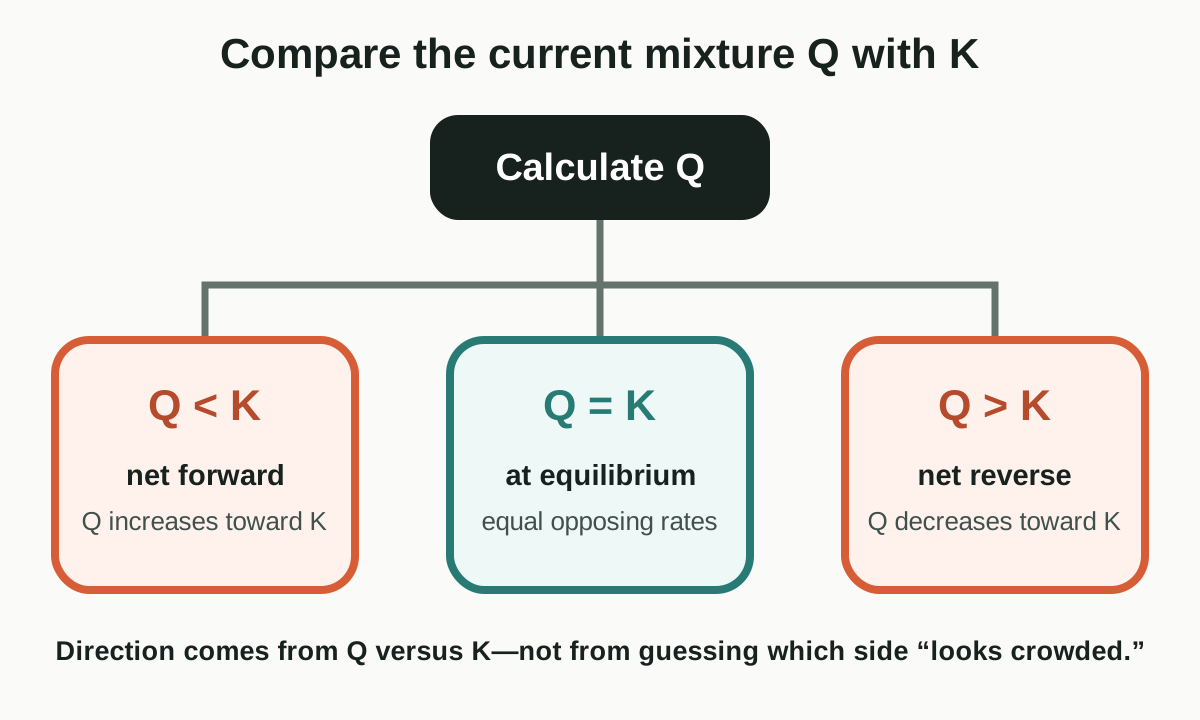
At constant temperature, changing a concentration or partial pressure immediately changes while stays fixed. The system then changes in the direction that restores . Temperature is different: changing temperature can change , because heat transfer changes the thermodynamic preference of the reaction.
For , Adding makes larger. If , net reverse reaction consumes until equilibrium is re-established.
A correct explanation connects three levels: the imposed change alters particle populations, collision frequencies change the forward or reverse rate, and composition evolves until the two rates are equal again. “The system shifts to oppose change” is a shortcut, not a causal explanation.
How do concentration and temperature disturbances affect an equilibrium mixture?
Wear splash goggles and appropriate gloves; use microscale quantities in a ventilated laboratory; avoid skin and eye contact. If exposure occurs, notify the instructor immediately and flush the affected area with water for at least 15 minutes. Collect all iron/thiocyanate mixtures in the instructor-designated hazardous aqueous-waste container; do not pour them down the drain or return reagents to stock containers. A teacher-supervised nonhazardous simulation is the lower-risk alternative, but it does not replace required supervised AP laboratory experience.
For each trial, state the disturbance, predicted change in Q, net reaction direction, rate-level explanation, observation, and uncertainty. Distinguish concentration effects (Q changes while K stays fixed) from temperature effects (K may change).
Design a quantitative calibration that converts color intensity to equilibrium concentration, then calculate an experimental K and propagate measurement uncertainty.